What is Sikh Golden Temple?什么是 Sikh Golden Temple?
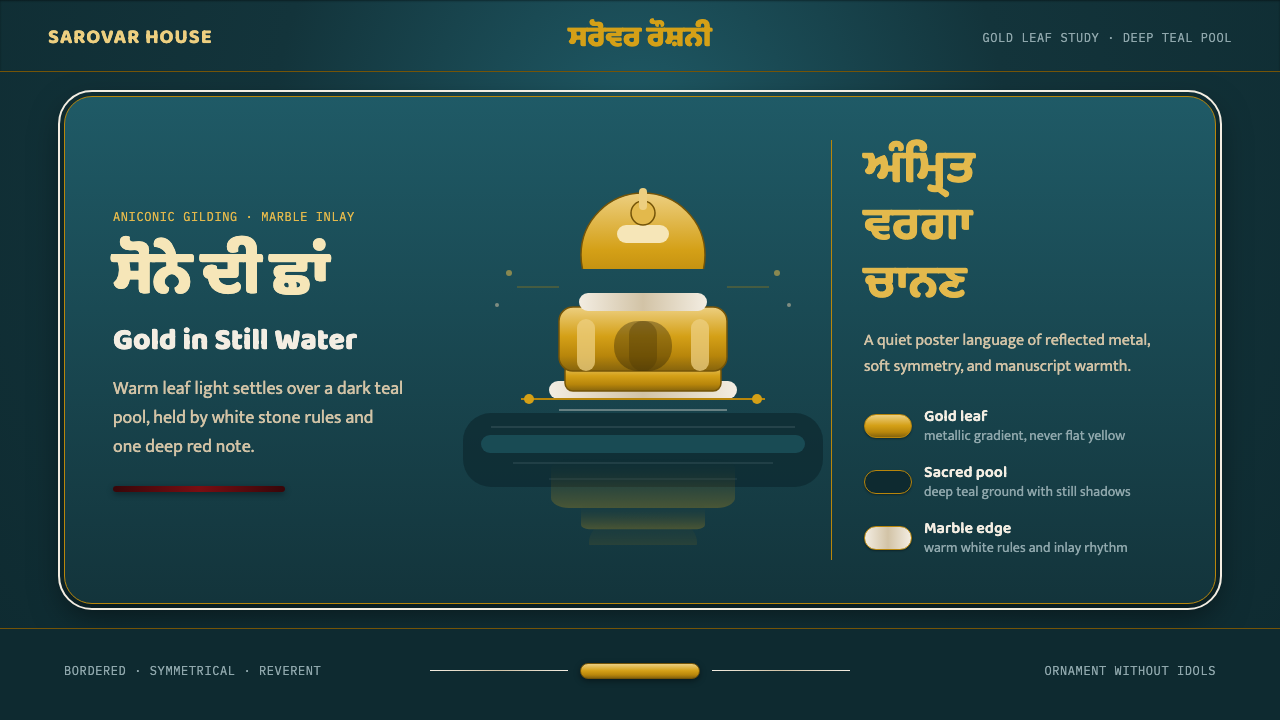
The Golden Temple's defining image is gold reflected in still, dark water — a reverent glow that never needs a single idol to carry its meaning.金庙最动人的画面是金色倒映在静水之上——一种庄重的光辉,无需任何一尊神像就能承载它的意义。
Sikh Golden Temple in briefSikh Golden Temple 速览
Sikh Golden Temple is a design language distilled from Harmandir Sahib, the Golden Temple of Amritsar — the most important gurdwara in Sikhism and the spiritual center of the faith. The building itself is modest in footprint: a low, square sanctuary set at the center of a large man-made pool, connected to the surrounding marble walkway by a single causeway. What makes it visually unforgettable is not scale but reflection — the gilded upper structure mirrors in the dark, still water of the sarovar (holy tank), doubling the gold and framing it inside a deep blue-green field that never quite goes black.锡克金庙这套设计语言,提炼自阿姆利则的哈尔曼迪尔·萨希卜——金庙,锡克教最重要的谒师所(gurdwara),也是这一信仰的精神中心。建筑本身占地并不大:一座低矮的方形圣殿坐落于一片人工圣池的中央,由一条单独的通道与四周的大理石步道相连。真正让它过目难忘的,不是规模,而是倒影——镀金的上部结构映照在圣池(甘露之池)幽深静止的水面上,让金色加倍呈现,并被框在一片深蓝绿色的水域之中,那水色始终没有真正沉入纯黑。
The system built from this image centers on that single relationship: luminous gold set against deep teal water, with white marble inlay work and deep carpet red providing the structural edges that hold the composition together. Ornament is abundant — floral and geometric marble inlay (pietra dura), gilded relief patterns, elaborate framing — but it is aniconic, meaning it never depicts a deity or a human figure. This is a direct visual consequence of Sikh theology, which rejects idol worship; the temple's visual richness comes entirely from pattern, material, and light rather than representational imagery.由这一意象构建出的设计系统,紧紧围绕着这一层关系展开:明亮的金色,衬于深青色的水面之上,白色大理石镶嵌工艺与深红色地毯为构图提供了支撑边界。装饰极为丰富——花卉与几何图案的大理石嵌花(pietra dura)、镀金浮雕纹样、繁复的边框——但它是无偶像的,意味着它从不描绘神祇或人物形象。这是锡克教神学的直接视觉后果:该教反对偶像崇拜;金庙视觉上的丰富感,完全来自图案、材质与光线,而非具象图像。
The overall mood is warm and reverent rather than opulent or ostentatious. Gold here reads as gilding applied with devotional intent — a physical offering of wealth made sacred through use — rather than as a signal of luxury for its own sake. The style asks any application of it to hold that same tension: gold that glows without glaring, pattern that fills space without ever depicting a face.整体氛围温暖而庄重,而非奢华炫耀。这里的金色读起来是带着虔敬意图施加的镀金——一种通过使用而变得神圣的物质性奉献——而非为炫耀本身而存在的奢华信号。这种风格要求任何应用它的场合都保持同样的张力:金色能发光却不刺目,图案能填满空间却从不描绘一张面孔。
See the Sikh Golden Temple design system查看 Sikh Golden Temple 完整设计系统
Where does Sikh Golden Temple come from?Sikh Golden Temple 从何而来?
Harmandir Sahib was founded by Guru Arjan, the fifth Sikh Guru, in the late sixteenth and early seventeenth centuries, with construction largely completed around 1604 when the Guru also installed the Adi Granth — the first compiled version of the Sikh scripture — within the sanctuary. From its founding, the temple was designed with a deliberately open, four-sided entrance, symbolizing that people of every caste, background, and direction were welcome to enter — a radical architectural statement of the Sikh rejection of caste hierarchy at a time when temple access in South Asia was often tightly restricted.哈尔曼迪尔·萨希卜由锡克教第五代古鲁阿尔琼于十六世纪末至十七世纪初创建,主体建造大致在1604年完成,同年古鲁将《阿迪·格兰特》——锡克教圣典的首个编纂版本——安放于圣殿之内。从建成之初,这座圣殿就被设计为刻意开放的四面入口,象征着无论种姓、出身或来自哪个方向,人人皆可进入——这在南亚寺庙准入常常受到严格限制的年代,是锡克教反对种姓等级制度的一项激进建筑宣言。
The temple's most iconic feature — its gold — is a later addition. The building endured repeated attacks and desecration during the eighteenth century, including by Afghan invader Ahmad Shah Durrani, and was rebuilt multiple times by the Sikh community. Its defining gilded transformation came in the early nineteenth century under Maharaja Ranjit Singh, the founder of the Sikh Empire, who in 1830 ordered the upper stories of the sanctuary covered in gold leaf — historically estimated at roughly 750 kilograms — as an act of devotional patronage. This is the gilding that gives the temple its English name and its defining visual identity.金庙最标志性的特征——它的金色——其实是后来才添加上去的。十八世纪期间,这座建筑屡遭袭击与亵渎,包括阿富汗入侵者艾哈迈德·沙阿·杜兰尼的破坏,锡克社群曾多次将其重建。它那具有决定性意义的镀金改造,出现在十九世纪初,由锡克帝国的创立者兰季特·辛格大君主持——他于1830年下令将圣殿上部楼层覆以金箔,据史料估计用量约七百五十公斤,作为一项虔诚的供养行为。正是这次镀金赋予了这座建筑英文名称中的“金色”,也塑造了它标志性的视觉身份。
The building sits at the center of the Amrit Sarovar, the sacred pool from which Amritsar (literally 'pool of nectar') takes its name, said to have healing properties in Sikh tradition. Pilgrims circumambulate the marble parikrama (walkway) surrounding the pool, and the causeway leading to the temple itself is a single narrow bridge, reinforcing the sense of the sanctuary as a destination reached rather than a building simply encountered.这座建筑坐落于“甘露之池”(Amrit Sarovar)的中央,阿姆利则(字面意思是“甘露之池”)这座城市的名字正是由此而来,锡克教传统认为这片圣池具有疗愈之力。朝圣者沿着环绕圣池的大理石回廊(parikrama)绕行,而通往圣殿本身的通道只是一座狭窄的单向桥,强化了圣殿是一处需要抵达的目的地、而非仅仅被路过的建筑这一意味。
The marble surfaces of the surrounding complex are worked in pietra dura, an inlay technique using cut and fitted semi-precious stone to form floral and geometric patterns — a craft tradition shared with, and roughly contemporary to, the marble work at the Taj Mahal, reflecting the broader Mughal-era decorative vocabulary that Sikh architecture absorbed and adapted even while developing its own distinct religious and political identity.周边建筑群的大理石表面运用了嵌花工艺(pietra dura)——一种切割并拼合半宝石以形成花卉与几何图案的技法,这一工艺传统与泰姬陵的大理石工艺同源、年代大致相仿,反映出锡克建筑在发展自身独特的宗教与政治身份的同时,也吸收并改造了更广泛的莫卧儿时代装饰词汇。
What defines the Sikh Golden Temple look?Sikh Golden Temple 的视觉特征是什么?
Color色彩
The palette is built on a single dominant contrast: warm gold against deep teal water. Gold ranges from bright metallic highlight to a more muted antique tone depending on how much reflected light it carries; teal is kept dark and saturated enough to read as still water rather than a bright decorative field. Deep carpet red and white marble round out the palette as structural, framing colors — red for interior warmth and ceremony, white for the clean geometric edges of inlay and walkway.色板建立在一组单一的主导对比之上:温暖的金色对深青色的水面。金色随反射光量的多少,从明亮的金属高光变化到更内敛的古铜色调;青色保持足够深沉与饱和,读起来是静止的水面,而非明亮的装饰色域。深红地毯与白色大理石作为结构性、边框性的色彩补齐色板——红色带来室内的暖意与仪式感,白色则勾勒出嵌花与步道那干净的几何边界。
Aniconic Ornament无偶像装饰
Every ornamental element — floral inlay, geometric border, gilded relief — must remain non-figurative. No human or divine figures appear anywhere in the system, in direct reflection of Sikh theology's rejection of idol worship. This is a hard constraint, not a stylistic preference: it distinguishes the style sharply from other South Asian temple traditions that do incorporate figurative sculpture and imagery.每一处装饰元素——花卉嵌花、几何边框、镀金浮雕——都必须保持非具象。系统中任何地方都不出现人物或神祇形象,这直接反映了锡克教神学对偶像崇拜的拒绝。这是一条硬性约束,而非风格偏好:它使这种风格与其他确实采用具象雕塑与图像的南亚寺庙传统明确区分开来。
Reflection and Water倒影与水面
Still, dark water is treated as a compositional device that doubles the gold rather than as mere background — a golden form and its mirrored reflection together, framed by the darker teal of the pool. Where the system is applied to interfaces, this can translate into a duplicated or mirrored visual motif along a horizontal axis, echoing the temple-and-reflection relationship without depicting the building literally.静止幽深的水面被当作一种能让金色加倍的构图手法来处理,而不仅仅是背景——一个金色形态与它的镜中倒影共同呈现,被水池更深的青色所框定。当这套系统应用于界面时,这可以转化为沿水平轴线出现的重复或镜像视觉母题,呼应寺庙与倒影之间的关系,而不必字面地描绘建筑本身。
Marble Inlay (Pietra Dura)大理石嵌花
White marble ruled lines and inlaid floral or geometric patterns act as the system's structural edges — dividing sections, framing panels, bordering content the way physical inlay borders a wall panel or walkway edge. These rules are precise and fine, never heavy, echoing the delicacy of cut-stone inlay work.白色大理石的分割线以及嵌入其中的花卉或几何图案,充当着系统的结构性边界——分隔板块、框住面板、为内容勾边,就像实体的嵌花为墙面板或步道边缘勾边一样。这些线条精细而准确,绝不厚重,呼应着切石嵌花工艺本身的细腻。
Gilded Glow, Not Glare镀金的光辉而非刺眼
Gold is rendered as a warm, contained glow — light gathered and held rather than scattered brightly outward. This mirrors the physical experience of viewing the temple: the gold catches ambient and reflected light and radiates warmth, but the overall scene remains calm and dim rather than dazzling. A version of this style that makes gold read as loud or garish has lost the temple's essential quiet.金色被呈现为一种温暖、内敛的光辉——是被汇聚并留驻的光,而非向外明亮散射的光。这呼应着观赏这座建筑时的真实体验:金色捕捉着周围与反射的光线并散发出暖意,但整体场景依然平静、幽暗,而非炫目耀眼。一个把金色处理得喧闹或俗艳的版本,就已经失去了这座圣殿最本质的宁静。
Devotional Ceremony虔敬的仪式感
Composition favors centered, symmetrical arrangements with a clear single focal point, echoing the temple's own axial approach across the causeway toward the sanctuary. This is not decorative symmetry for its own sake but a formal expression of pilgrimage and approach — the eye is meant to travel toward one gilded center the way a visitor's feet travel toward one gilded building.构图偏爱居中、对称的布局,带有清晰的单一焦点,呼应着建筑本身经由通道走向圣殿的轴线式路径。这并非为对称而对称的装饰手法,而是朝圣与抵达的一种形式化表达——视线被引导走向一个镀金的中心,正如朝圣者的脚步走向一座镀金的建筑。

See the Sikh Golden Temple design system查看 Sikh Golden Temple 完整设计系统
Who shaped Sikh Golden Temple?谁塑造了 Sikh Golden Temple?
The fifth Sikh Guru, Guru Arjan oversaw the founding and construction of Harmandir Sahib in the late sixteenth and early seventeenth centuries and installed the Adi Granth within it, establishing the temple as the central seat of Sikh scripture and worship. His decision to build the sanctuary with entrances on all four sides remains one of the clearest architectural expressions of Sikh egalitarian theology.作为锡克教第五代古鲁,阿尔琼在十六世纪末至十七世纪初主持了哈尔曼迪尔·萨希卜的创建与建造,并将《阿迪·格兰特》安放其中,使这座圣殿成为锡克教经典与礼拜的中心所在。他决定让圣殿四面均设入口的做法,至今仍是锡克教平等主义神学最清晰的建筑表达之一。
The founder of the Sikh Empire, Ranjit Singh ordered the gilding of the temple's upper structure in 1830, the act that gave the building its English name and its defining visual character. His patronage reflected both personal devotion and the political consolidation of Sikh identity under a unified empire, using architectural magnificence as a statement of both.作为锡克帝国的创立者,兰季特·辛格于1830年下令为圣殿上部结构镀金,正是这一举动赋予了这座建筑英文名称以及它标志性的视觉特征。他的这份供养,既反映出个人的虔诚,也体现出在统一帝国之下巩固锡克身份的政治意图,以建筑上的辉煌来同时表达这两者。
The anonymous artisans who executed the temple complex's marble inlay work drew on a craft tradition shared across the Mughal-era subcontinent, adapting techniques associated with monuments like the Taj Mahal to a distinctly Sikh architectural and devotional context. Their work supplies the fine geometric and floral detailing that frames the temple's gold.执行金庙建筑群大理石嵌花工艺的无名工匠们,承袭着莫卧儿时代整个次大陆共享的手艺传统,将泰姬陵等纪念建筑所用的技法,改造应用于一种鲜明的锡克教建筑与礼拜语境之中。他们的作品提供了框住寺庙金色的那些精细几何与花卉细节。
How do you use Sikh Golden Temple today?今天怎么用 Sikh Golden Temple?
Sikh Golden Temple applies well to any digital product wanting to convey reverence, warmth, and dignified ceremony without leaning on figurative or overtly religious imagery — hospitality and heritage-tourism sites, cultural institution pages, luxury goods that want gold without garishness, or platforms telling a story of devotion and craft. Because the style is drawn from a specific and living religious tradition, applying it respectfully means keeping its aniconic constraint intact rather than treating gold-on-teal purely as a decorative palette.锡克金庙这套风格,很适合任何想要传达庄重、温暖与有尊严的仪式感、同时又不依赖具象或明显宗教图像的数字产品——款待与文化旅游网站、文化机构页面、想要金色而不显俗气的奢侈品,或是讲述虔诚与手艺故事的平台。由于这种风格取材于一个具体而鲜活的宗教传统,恰当地应用它,意味着保持其无偶像的约束不被打破,而不是把金配青色纯粹当作一种装饰色板来使用。
For presentation slides, a cover works well built on a deep teal field with a centered gilded form — an abstracted arch, medallion, or geometric motif rather than a literal building silhouette — and its faint mirrored reflection beneath it, evoking the temple-and-water relationship without depicting the structure directly. Content slides benefit from symmetrical, centered layouts with fine white-line dividers standing in for marble inlay borders, and a restrained, ceremonial pacing — one idea per slide, generously spaced, rather than dense grids of information.在演示文稿中,一个建立在深青色场域上、居中呈现镀金形态(抽象化的拱门、徽章或几何母题,而非字面的建筑轮廓)的封面效果很好,其下方带有一处淡淡的镜像倒影,呼应寺庙与水面的关系,而不直接描绘建筑本身。内容页得益于对称、居中的版面,用细白线分隔来代替大理石嵌花边界,节奏克制而有仪式感——每页一个观点,留白慷慨,而非密集的信息网格。
For web interfaces, the palette suits landing pages, about pages, and hero sections for brands built around heritage, ceremony, or craft far better than data-dense dashboards, where the dark teal ground and low-contrast gold would frustrate scanning. A hero section might use a deep teal-to-black gradient ground with a warm gold accent reserved for a single focal element — a logotype, a primary call to action — echoing the temple's use of gold as a singular, glowing point within a dark field.对于网页界面,这套色板更适合款待、传承或手艺品牌的落地页、关于页面与主视觉区,而不太适合数据密集的仪表板,那里深青色底面与低对比度的金色会让扫读变得吃力。主视觉区可以使用从深青到黑的渐变底面,把暖金色的强调保留给一个单一的焦点元素——一个标志、一个主要的行动号召按钮——呼应寺庙把金色当作暗色场域中一处独一无二的发光焦点这一手法。
For editorial and marketing work, the style favors long-form storytelling over dense informational layout: heritage brand narratives, cultural travel writing, or luxury product stories that want warmth without ostentation. Pull quotes and section breaks read well framed by fine white rules echoing marble inlay, and imagery should favor architectural or textile detail over literal figurative photography if the aniconic principle is to be honored.对于编辑与营销内容,这种风格偏爱从容的长篇叙事,而非密集的信息版面:传承品牌叙事、文化旅行写作,或是想要温暖而不炫耀的奢侈品故事。引言与段落分隔用呼应大理石嵌花的细白线来框定效果很好,如果要恪守无偶像原则,图像应偏向建筑或纺织品的细节,而非字面的具象人物摄影。
A common mistake is treating the gold-and-teal palette as purely decorative and losing the aniconic discipline — introducing figurative illustration, iconography, or ornamental motifs that read as devotional imagery of a person or deity. A second common mistake is oversaturating the gold until it reads as generic 'luxury gold' rather than the specific warm, reflected glow of gilding on water; the style depends on restraint in how much gold appears and how brightly it is rendered, not on maximizing gold coverage.一个常见的错误是把金配青色的色板当作纯装饰性的处理,从而失去了无偶像的纪律——引入具象插画、图腾或读起来像是在描绘某个人物或神祇的装饰母题。第二个常见错误是把金色调得过于饱和,直到它读起来像是泛泛的“奢华金”,而非镀金映在水面上那种特定的、温暖的反射光辉;这种风格依赖于对金色出现的分量与亮度的克制,而非追求金色覆盖面积的最大化。
See the Sikh Golden Temple design system查看 Sikh Golden Temple 完整设计系统
Sikh Golden Temple — FAQSikh Golden Temple · 常见问题
Why does the style forbid figurative imagery?这种风格为什么禁止使用具象图像?
Because Sikh theology explicitly rejects idol worship, and Harmandir Sahib's own decoration reflects that: every ornamental surface in and around the temple is pattern, geometry, or inlay work rather than depiction of a deity or human figure. A design system drawn from the temple that introduced figurative or iconographic imagery would misrepresent the tradition it is meant to honor, so the aniconic constraint is treated as a hard rule rather than an optional stylistic choice.因为锡克教神学明确反对偶像崇拜,金庙自身的装饰也体现了这一点:寺庙内外的每一处装饰表面都是图案、几何或嵌花工艺,而非对神祇或人物形象的描绘。一套取材于这座寺庙的设计系统,如果引入具象或图腾式的图像,就会曲解它本应致敬的这一传统,因此无偶像的约束被当作一条硬性规则,而非可选的风格取舍。
Can this style work with a light background instead of dark teal?这种风格能用浅色背景代替深青色吗?
Not while remaining true to the source image. The style's emotional core is gold glowing out of dark, still water — a light background removes that contrast entirely and the composition stops evoking the temple's most recognizable view. If a lighter variant is needed, it is better achieved by lightening the teal only slightly, toward a deep muted blue-green, rather than shifting to a pale or white ground.如果要忠于原始意象,就不太行。这种风格的情感核心是金色从幽深静止的水面中发光而出——浅色背景会完全消除这种对比,构图也就不再唤起金庙最具辨识度的那一眼画面。如果确实需要更浅的变体,更好的做法是只把青色略微提亮,转向一种深沉、内敛的蓝绿色,而不是转向浅淡或纯白的底色。
How much gold should appear in a composition using this style?在使用这种风格的构图中,金色应该占多大比例?
Less than intuition suggests. In the source image, gold is a relatively small, concentrated area against a much larger field of dark water and sky — its impact comes from contrast and reflection, not from coverage. Applications that fill most of the composition with gold lose that contrast and tend to read as generic luxury branding rather than the specific reverent glow the style is built around.比直觉想象的要少。在原始意象中,金色是一块相对较小、集中的区域,衬于大面积幽深水面与天空之上——它的冲击力来自对比与反射,而非覆盖面积。如果应用把构图的大部分都填满金色,就会失去这种对比,读起来更容易变成泛泛的奢华品牌形象,而非这种风格所依托的那种特定的庄重光辉。
Does this style suit playful or casual brands?这种风格适合轻松、休闲的品牌吗?
Generally not. The style's entire register is reverent and ceremonial, drawn directly from a place of active religious devotion. Applying it to a casual, playful, or irreverent context risks trivializing imagery with genuine sacred meaning to a living community. It is best reserved for contexts — heritage, hospitality, cultural storytelling, dignified luxury — where a tone of warmth and reverence is actually appropriate.一般来说不适合。这种风格的整体基调是庄重而具仪式感的,直接取材于一处仍在被虔诚信奉的宗教场所。把它应用于轻松、玩闹或不庄重的语境,有可能让对一个活生生的社群而言具有真实神圣意义的意象变得轻浮。它最好保留给那些温暖与庄重的基调确实合适的语境——传承、款待、文化叙事、有尊严的奢华。
What distinguishes this style from generic 'gold and teal' color schemes?这种风格与泛泛的“金配青”配色方案有什么区别?
The aniconic ornament, the reflection-based composition, and the specific narrow value range of the teal (dark and still, never bright or turquoise-bright) all distinguish it from a generic gold-teal palette used decoratively. A generic version treats gold and teal as interchangeable brand colors; this style treats them as the specific record of one physical, devotional scene, with pattern and symmetry built around a single reflected focal point.无偶像的装饰、以倒影为基础的构图,以及青色那特定而狭窄的明度区间(深沉静止,绝非明亮或亮松石绿),都使它区别于一种纯装饰性使用的泛泛金配青配色。泛泛的版本把金色与青色当作可互换的品牌色;这种风格则把它们当作对一处具体、虔敬场景的特定记录,图案与对称性都围绕着一个单一的反射焦点来构建。
Related design styles相关设计风格
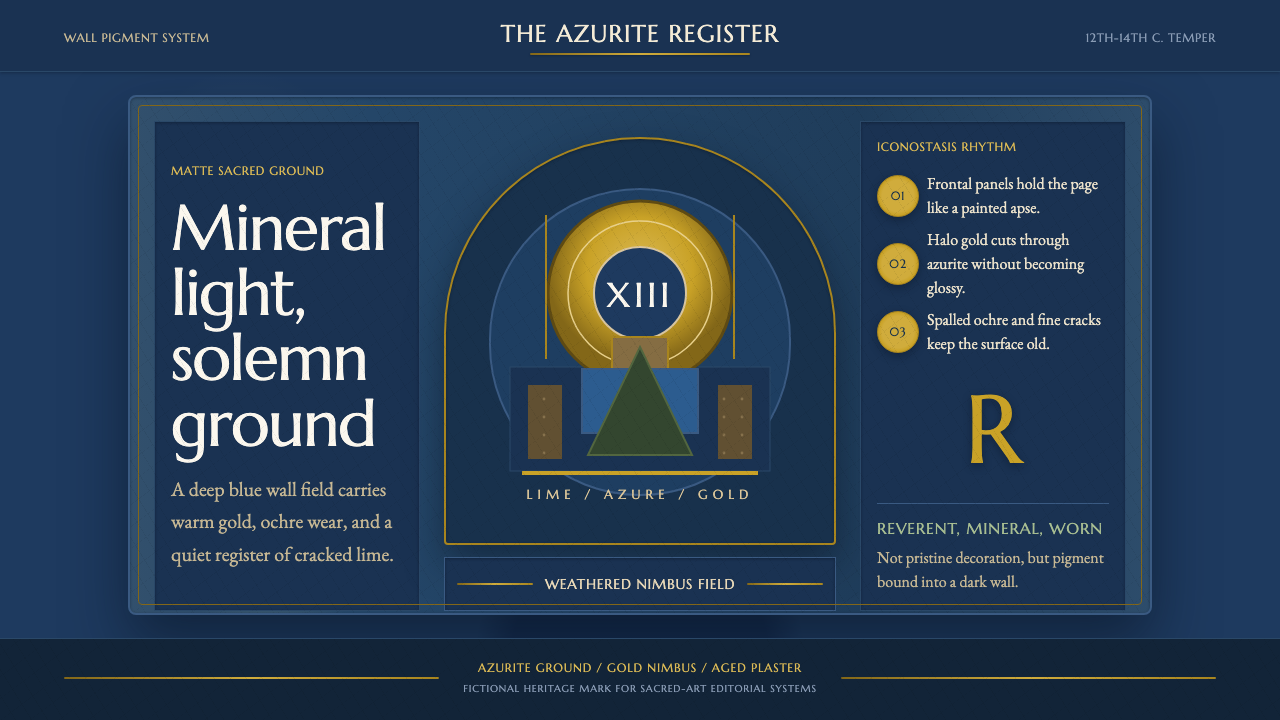 Serbian Medieval FrescoSacred wear becomes structure. Azurite fields, gold halos, and cracked plaste…神圣磨损成为结构。蓝铜矿底、金色光环与龟裂灰泥撑起画框。
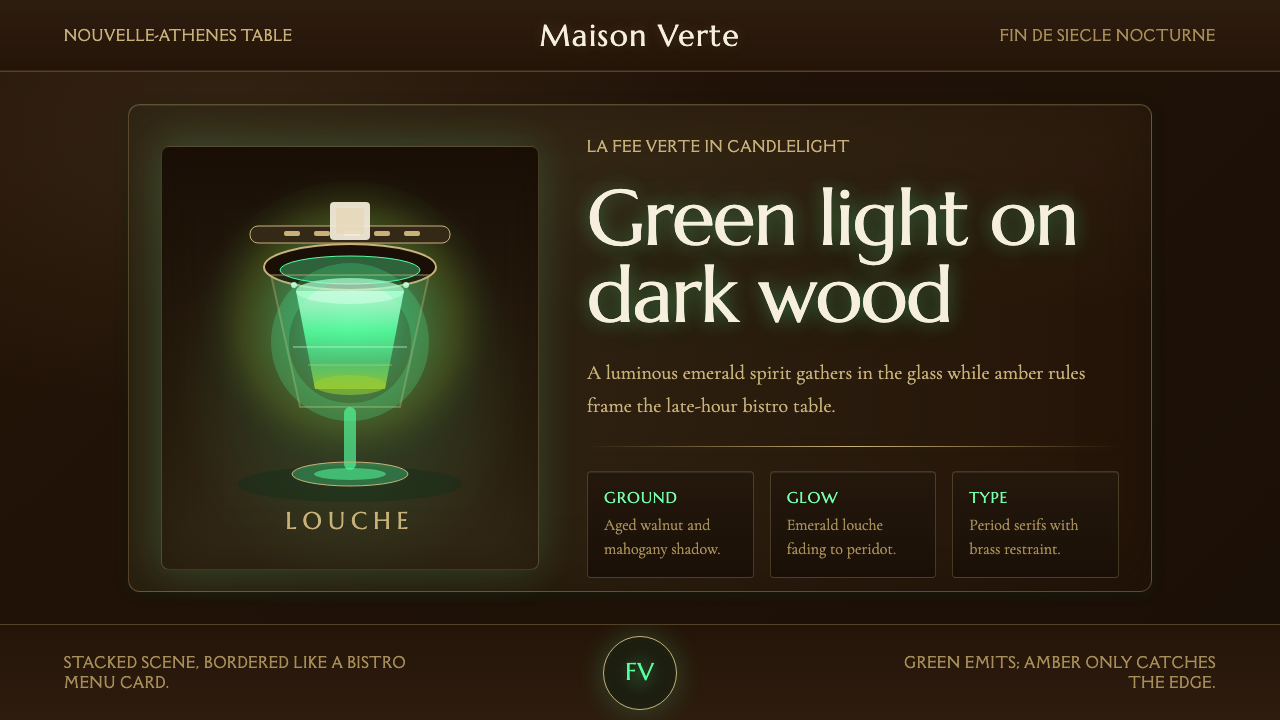 Absinthe Green Fairy GlowDarkness makes the fairy glow. Emerald louche on mahogany, framed by amber se…黑暗托起绿仙微光。桃花心木上翠绿乳浊,琥珀衬线收边。
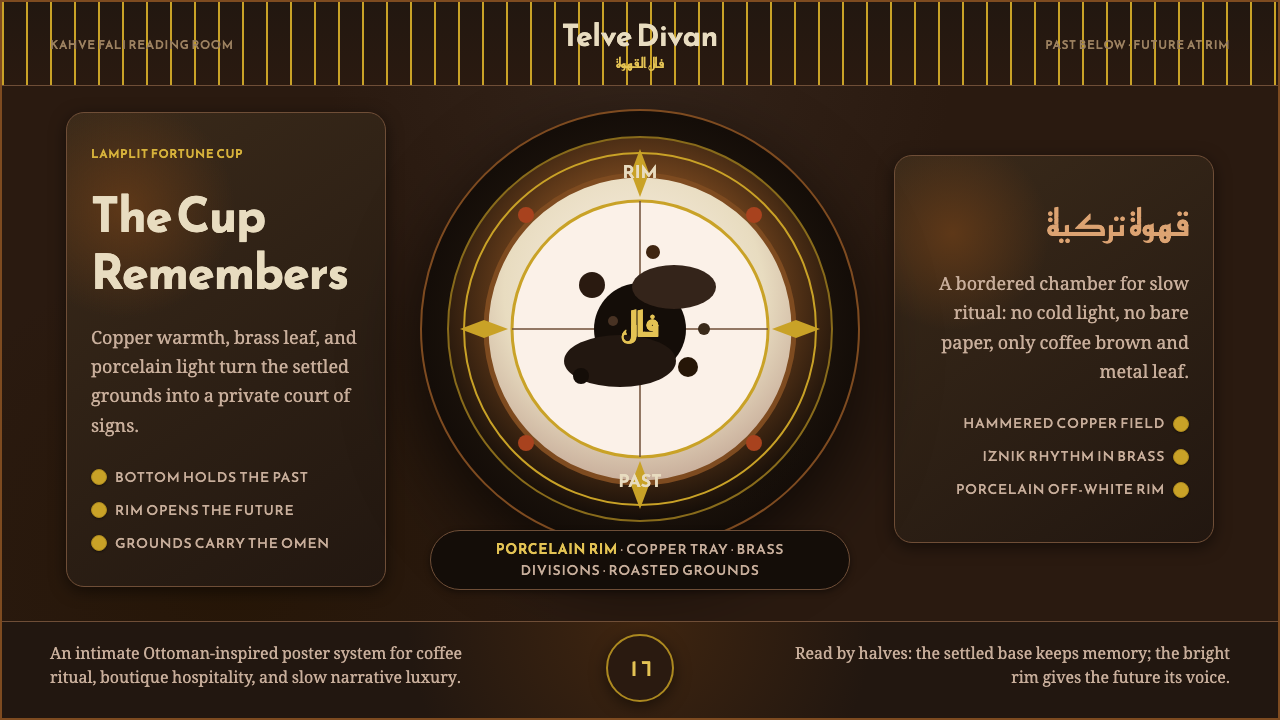 Turkish Coffee FortuneLamplit ritual, richly framed. Copper, brass, and Reem Kufi orbit a porcelain…油灯下的仪式感。铜、黄铜与Reem Kufi环绕瓷杯。
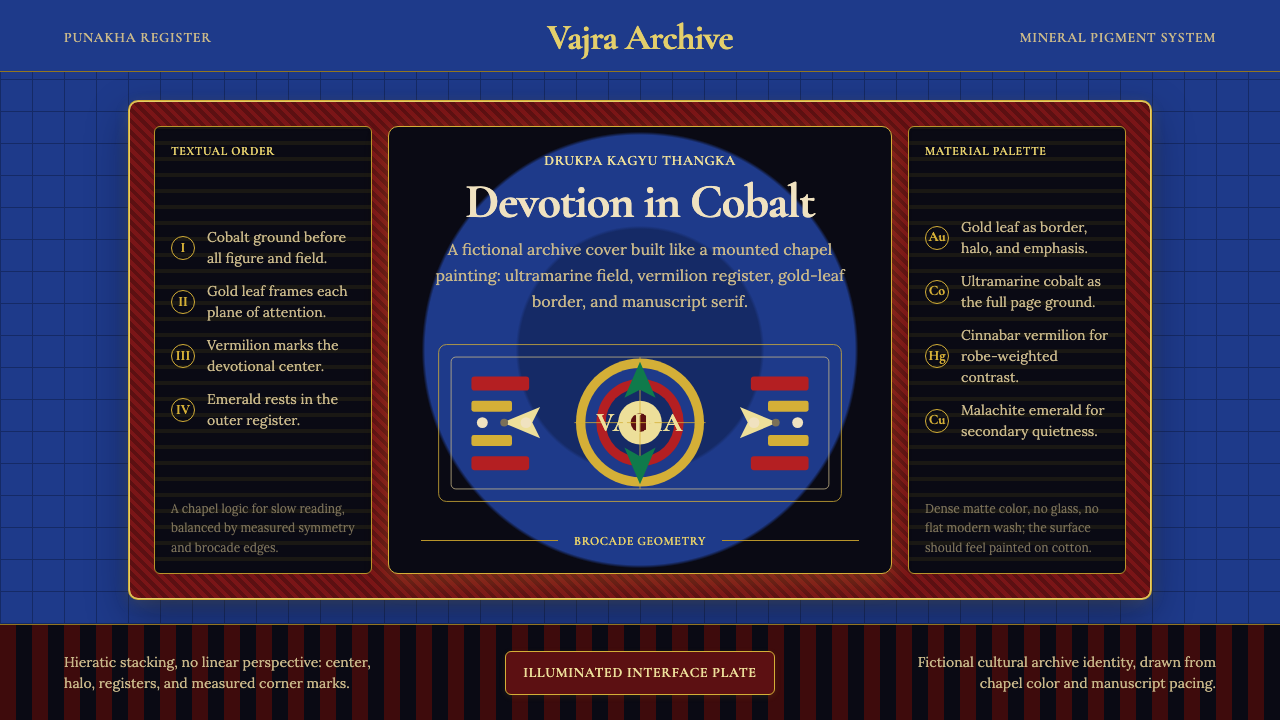 Bhutanese Drukpa Kagyu ThangkaDevotion made cobalt. Gold frames, Cormorant serif, and vermilion marks hold…钴蓝承载虔敬:金框、Cormorant 衬线与朱砂标记构成佛殿秩序。
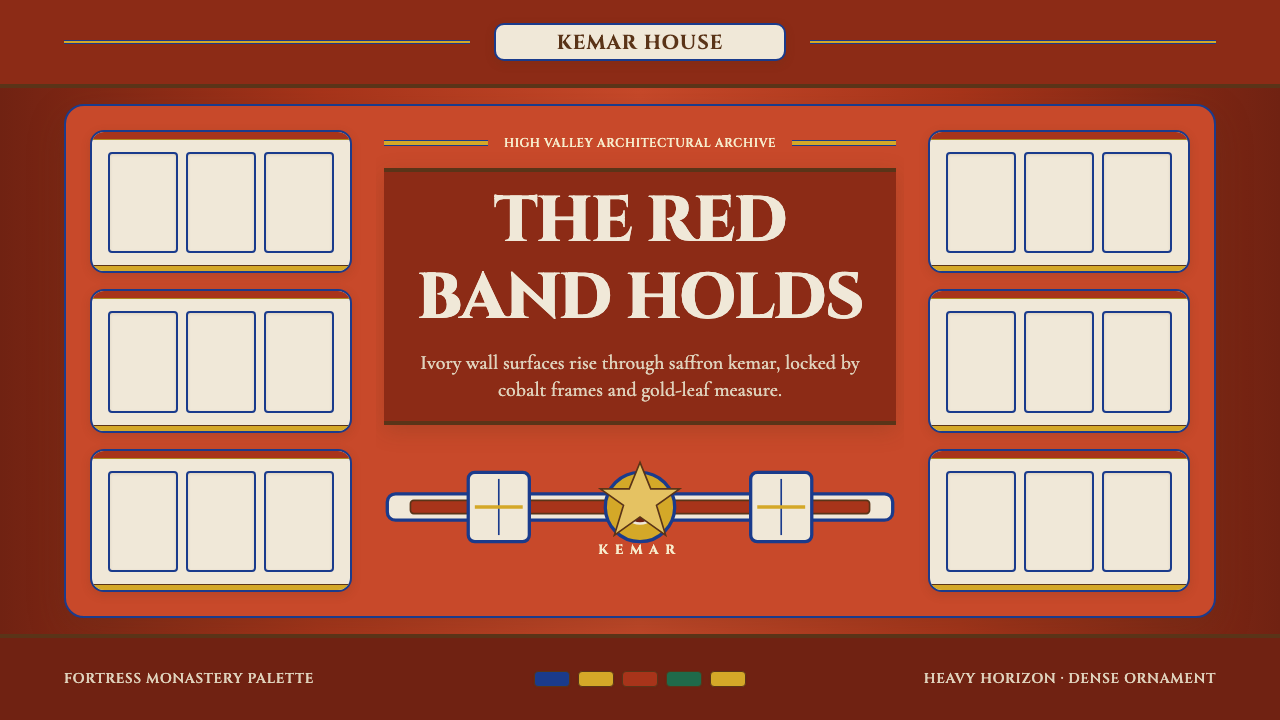 Bhutanese Dzong (Fortress Red)Monumental red holds the page. Cobalt frames and gold bands lock the fortress…厚重藏红掌控页面。钴蓝窗框与金色横带锁定宗堡节奏。
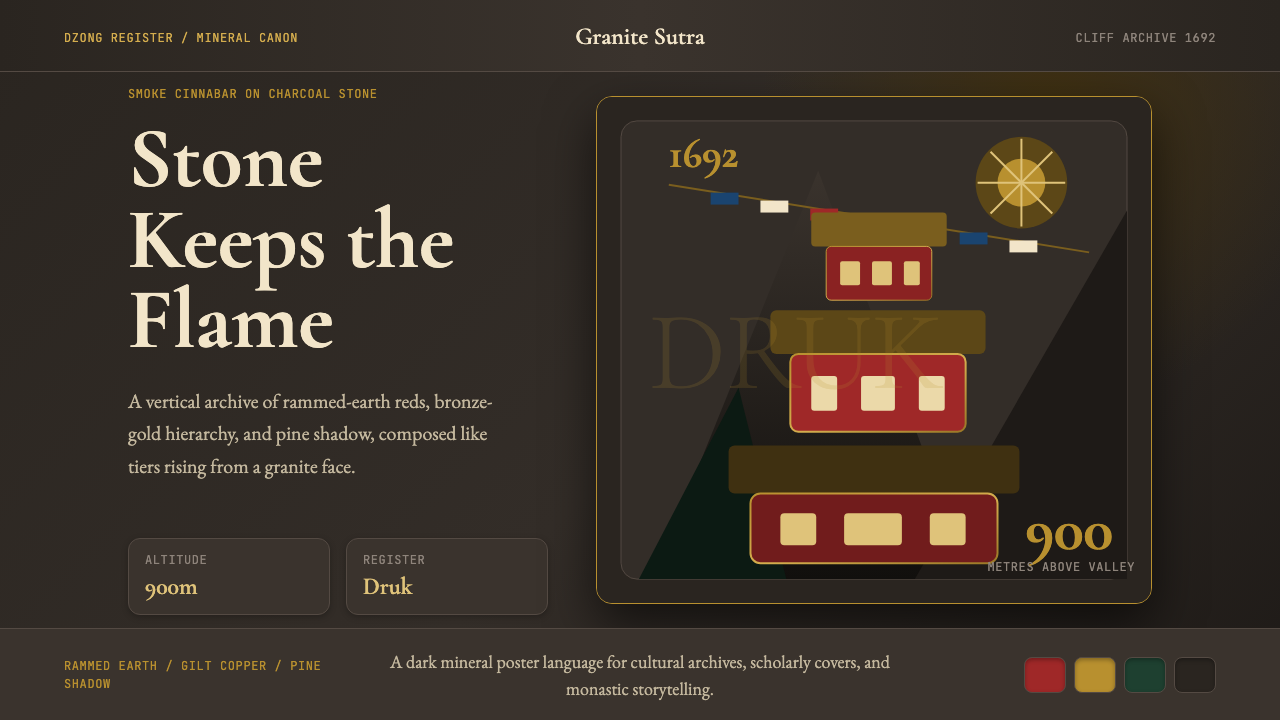 Bhutanese Tiger's Nest Cliff MonasterySacred altitude, mineral-dark. Cinnabar tiers and bronze rules climb charcoal…神圣垂直感。朱砂层台与青铜线条攀上炭灰花岗岩。