What is Armillary Sphere?什么是 Armillary Sphere?
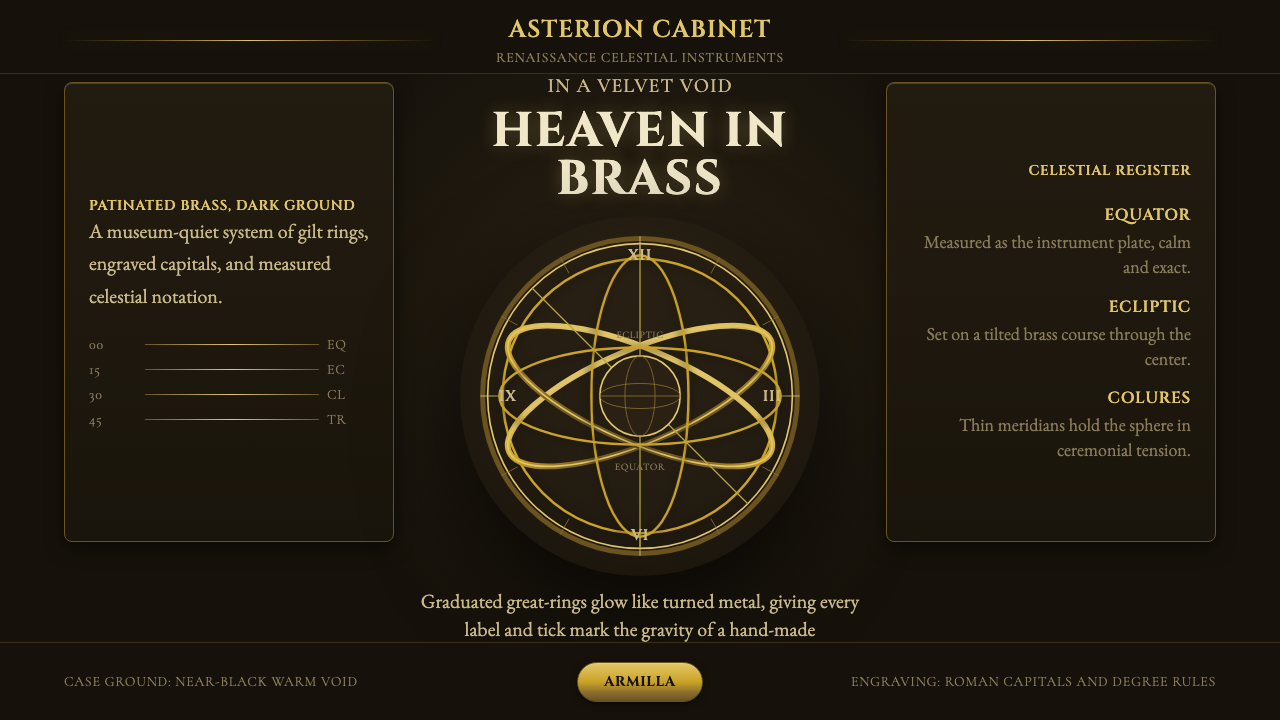
The armillary sphere is the oldest model of the heavens still made by hand — a cage of graduated brass rings kept alive in museum darkness that turns metal into celestial light.浑天仪是至今仍以手工制作、最古老的天体模型——一圈圈刻度铜环所构成的笼子,在博物馆的暗场中,把金属变成了天体的光。
Armillary Sphere in briefArmillary Sphere 速览
Star Globe Armillary Sphere is a design system drawn from the armillary sphere, an astronomical instrument built as a cage of graduated brass rings — representing the celestial equator, ecliptic, colures, and tropics — wrapped concentrically around a small central globe representing the Earth. It is one of the oldest scientific instruments still produced by hand today, its basic form essentially unchanged since antiquity even as its purpose shifted from working scientific tool to museum artifact and decorative object.「浑天仪」这套设计体系,取材自浑天仪本身——一件由一圈圈刻度铜环构成的天文仪器,代表天球赤道、黄道、二分二至圈与回归线,同心环抱着代表地球的中央小球体。它是当今仍以手工制作的最古老的科学仪器之一,其基本形制自古典时代以来基本未变,即便它的用途已从实用的科学工具转变为博物馆展品与装饰性物件。
The system's defining visual move is its staging: rather than presenting the brass rings against a bright, neutral background as a technical diagram might, this style borrows the specific convention of museum display cases, where such instruments are typically lit against a deliberately dark, near-black ground. This darkness is not incidental — it is what makes the warm brass glow read as celestial rather than merely metallic, echoing the way the instrument itself was meant to model a dark night sky.这套体系最具决定性的视觉手法,在于它的陈列方式:与其像技术图解那样把铜环呈现在明亮、中性的背景之上,这种风格借用了博物馆展柜的特定惯例——这类仪器通常在深邃、近乎全黑的暗场背景中受光照亮。这种暗场并非无关紧要——正是它让温润的黄铜光泽读起来像是天体之光,而非仅仅是金属光泽,呼应了这件仪器本就意在模拟一片暗夜星空的初衷。
Every ring carries engraved markings — degree graduations, zodiac glyphs, Roman numerals — rendered in a way that suggests hand-cut precision rather than printed or digital labeling. Cinzel, a modern typeface modeled on classical Roman capital letterforms, provides the system's typographic voice, reinforcing the instrument's deep historical lineage stretching back through Renaissance instrument workshops to Greek antiquity.每一道铜环都刻有铭文标记——刻度分划、黄道符号、罗马数字——以一种暗示手工镌刻精度、而非印刷或数字标注的方式呈现。Cinzel——一款以古典罗马大写字母为模板的现代字体——为这套体系提供了字体上的声音,强化了这件仪器可追溯至文艺复兴仪器作坊、直至希腊古典时代的深厚历史渊源。
See the Armillary Sphere design system查看 Armillary Sphere 完整设计系统
Where does Armillary Sphere come from?Armillary Sphere 从何而来?
The armillary sphere's origins reach back to Greek antiquity, where astronomers such as Eratosthenes, celebrated for his remarkably accurate calculation of the Earth's circumference around 240 BCE, and Ptolemy, whose geocentric astronomical model dominated Western thought for over a millennium, used ring-based instruments to model and calculate celestial positions. These early instruments were working scientific tools, built to demonstrate and calculate the movements of celestial bodies rather than to be admired as decorative objects.浑天仪的起源可追溯至希腊古典时代,当时的天文学家——如埃拉托斯特尼,以约公元前240年对地球周长惊人准确的计算而闻名,以及托勒密,其地心说天文模型主导西方思想长达千年之久——都曾使用基于圆环的仪器来建模并计算天体位置。这些早期仪器是实用的科学工具,为演示与计算天体运行而建造,而非作为装饰性物件供人欣赏。
The instrument was refined and elaborated through successive scientific traditions across centuries — Islamic astronomers preserved and advanced Greek astronomical instrument-making during the medieval period, and the tradition was later reabsorbed into Western Europe, where Renaissance instrument workshops transformed the armillary sphere into an object of considerable craft and artistic ambition, adding elaborate engraving, gilding, and decorative stands alongside its functional rings.这件仪器历经数百年的相继科学传统被不断精炼与丰富——伊斯兰天文学家在中世纪时期保存并发展了希腊的天文仪器制造,这一传统后来又被重新吸收进西欧,文艺复兴时期的仪器作坊将浑天仪转变为一件颇具工艺与艺术抱负的物品,在其功能性圆环之外,加入了繁复的雕刻、镀金与装饰性支架。
A pivotal later figure in this tradition is Tycho Brahe, the sixteenth-century Danish astronomer whose observatory at Uraniborg housed some of the largest and most precisely constructed astronomical instruments of the pre-telescope era, including large armillary spheres used for exceptionally accurate naked-eye observation. Brahe's meticulous data, gathered using instruments in this tradition, later provided the observational foundation Johannes Kepler used to derive his laws of planetary motion.这一传统中一位关键的后世人物是第谷·布拉赫——这位十六世纪的丹麦天文学家,其位于汶岛天堡的天文台,安置着前望远镜时代一些规模最大、构造最精密的天文仪器,包括用于极其精确肉眼观测的大型浑天仪。布拉赫借助这一传统仪器所搜集的细致数据,后来为约翰尼斯·开普勒推导其行星运动定律提供了观测基础。
As telescopic astronomy made the armillary sphere obsolete as a working scientific instrument by the seventeenth and eighteenth centuries, it transitioned into its current cultural role: a museum piece and a decorative object prized for its craft, its historical association with the birth of scientific astronomy, and its inherent visual elegance — concentric rings, engraved brass, classical proportion — independent of its original calculating function. This design system draws specifically on that later museum-display identity rather than on the instrument's working scientific use.随着望远镜天文学的发展,浑天仪在十七、十八世纪作为实用科学仪器逐渐被淘汰,它转向了如今的文化角色:一件博物馆藏品,一件因其工艺、因其与科学天文学诞生历史的关联、以及因其独立于原始计算功能之外的固有视觉优雅——同心的圆环、镌刻的黄铜、古典的比例——而受珍视的装饰性物件。这套设计体系具体借鉴的,正是这种后来的博物馆陈列身份,而非这件仪器最初的实用科学功能。
What defines the Armillary Sphere look?Armillary Sphere 的视觉特征是什么?
Museum Darkness博物馆暗场
The dominant ground is a deep, near-black void rather than a bright neutral backdrop. This staging choice is deliberately borrowed from museum display cases, where lighting is kept low to protect artifacts and to concentrate visual attention entirely on the illuminated object itself.主导底场是一片深邃、近乎全黑的虚空,而非明亮的中性背景。这一陈列选择是刻意借自博物馆展柜的——那里的照明保持低沉,既为保护文物,也为将全部视觉注意力集中在受光照亮的物件本身。
Brass and Gold黄铜与金色
Warm brass and gold tones carry all structural and decorative elements — rings, engraved markings, framing devices. Against the deep dark ground, these warm metallics read as glowing rather than simply reflective, an effect achieved through strong tonal contrast rather than any literal light-source rendering.温润的黄铜与金色调承载所有结构性与装饰性元素——圆环、镌刻标记、取景装置。衬着深邃的暗色底场,这些暖调金属色读起来是发光的,而非仅仅是反光的,这种效果是通过强烈的明度对比实现的,而非任何字面意义上的光源渲染。
Concentric Rings同心环
Multiple rings of varying diameter nest concentrically around a central point, each representing a distinct celestial reference plane. This concentric structure can organize layout hierarchy directly — an outer ring for primary navigation or category, inner rings for progressively more specific detail.多个直径不一的圆环以同心方式环绕一个中心点,每一环各自代表一个不同的天球参照平面。这种同心结构可以直接用来组织版面层级——外环用于主导航或分类,内环则用于逐渐更具体的细节。
Engraved Markings镌刻标记
Degree graduations, zodiac glyphs, and reference labels are rendered as if hand-cut into metal — fine, precise, slightly irregular linework rather than crisp digital vector marks. This engraved quality should feel like the product of a craftsman's hand and tool, not a printer.刻度分划、黄道符号与参照标签,以一种仿佛手工刻入金属的方式呈现——纤细、精确、略带不规则的线条,而非清晰的数字矢量标记。这种镌刻质感应当给人一种出自工匠之手与工具的感觉,而非出自打印机。
Cinzel Classical CapitalsCinzel古典大写字
Roman-inspired capital letterforms, modeled on classical inscriptional lettering, carry titles and key labels. Their carved, monumental quality echoes the same historical lineage as the instrument itself, tying the typography directly to the classical and Renaissance astronomical tradition.以古典铭刻字体为模板的罗马式大写字母,承载标题与关键标签。它们那种雕琢、纪念碑式的质感,呼应了这件仪器本身同样的历史渊源,将字体排印直接系于古典与文艺复兴时期的天文学传统之上。
Concentric Proportion同心比例
Ring spacing and diameter follow a deliberate, mathematically considered proportion rather than arbitrary spacing — reflecting the instrument's origin as a precision scientific tool where every ring's position corresponded to an actual celestial measurement. Even in a purely decorative application, this sense of considered, non-arbitrary geometry should be preserved.圆环的间距与直径遵循一种经过深思熟虑、数学考量的比例,而非随意的间距——反映了这件仪器作为精密科学工具的起源,其中每一道圆环的位置都对应着一次实际的天体测量。即便是在纯粹装饰性的应用中,这种经过考量、而非随意的几何感也应当被保留。
Selective Glow选择性发光
Not every surface glows equally — light is concentrated on the topmost or most structurally significant rings and markings, while recessed or background elements fall into deeper shadow. This selective illumination creates depth and hierarchy within the dark field rather than a flat, evenly lit brass surface.并非每个表面都均匀发光——光线集中在最上层或结构上最重要的圆环与标记上,而凹陷或背景元素则沉入更深的阴影之中。这种选择性的照明,在暗色画面中营造出深度与层级,而非一片扁平、均匀受光的黄铜表面。
See the Armillary Sphere design system查看 Armillary Sphere 完整设计系统
Who shaped Armillary Sphere?谁塑造了 Armillary Sphere?
The Greek astronomer and mathematician celebrated for calculating the Earth's circumference with remarkable accuracy around 240 BCE, using ring-based astronomical instruments among his tools. His work represents the earliest scientific foundation of the ring-instrument tradition this design system draws its historical weight from.希腊天文学家与数学家,以约公元前240年对地球周长的惊人精确计算而闻名,其所用工具中便包括基于圆环的天文仪器。他的工作代表了这套设计体系所汲取历史分量的、圆环仪器传统最早的科学基础。
The Greco-Roman astronomer whose geocentric model of the universe, using nested celestial spheres, dominated Western astronomical thought for over a thousand years. His theoretical framework directly informed how ring-based instruments like the armillary sphere were constructed and interpreted for centuries afterward.希腊-罗马天文学家,其以嵌套天球为基础的地心宇宙模型,主导西方天文学思想长达千年以上。他的理论框架直接影响了此后数百年间浑天仪等圆环式仪器的构造方式与解读方式。
The sixteenth-century Danish astronomer whose observatory at Uraniborg housed exceptionally large and precisely built astronomical instruments, including armillary spheres used for pre-telescope naked-eye observation. His meticulous observational data later enabled Johannes Kepler's laws of planetary motion, making Brahe's instrument tradition a direct link between ancient ring-instrument astronomy and modern scientific astronomy.十六世纪丹麦天文学家,其位于汶岛天堡的天文台安置着规模异常庞大、构造异常精密的天文仪器,包括用于前望远镜时代肉眼观测的浑天仪。他细致的观测数据后来使约翰尼斯·开普勒得以推导出行星运动定律,这使布拉赫的仪器传统成为古代圆环仪器天文学与现代科学天文学之间的一条直接纽带。
How do you use Armillary Sphere today?今天怎么用 Armillary Sphere?
Star Globe Armillary Sphere is a quiet, high-craft style built on contrast between deep darkness and warm engraved metal, and applying it well means preserving that near-black ground rather than brightening it for generic "gold and dark" luxury branding. The style depends specifically on the museum-display convention — dark enough that the brass genuinely appears to glow rather than simply sit on a colored background.「浑天仪」是一种安静、工艺感强烈的风格,建立在深邃暗场与温润镌刻金属之间的对比之上,要用好它,需要保留这种近黑的底场,而非为了泛泛的「金色配暗色」奢华品牌感而将其调亮。这种风格具体依赖于博物馆陈列的惯例——暗到足以让黄铜真正看起来像在发光,而非仅仅置于一块有色背景之上。
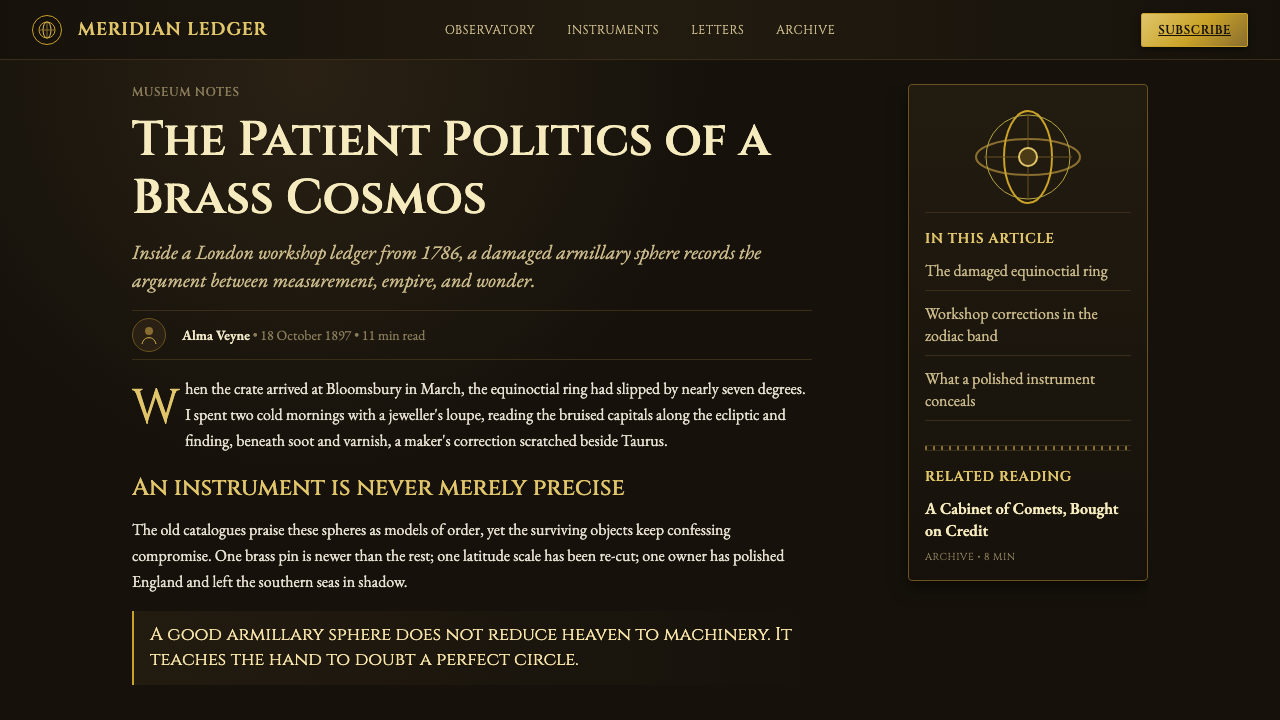
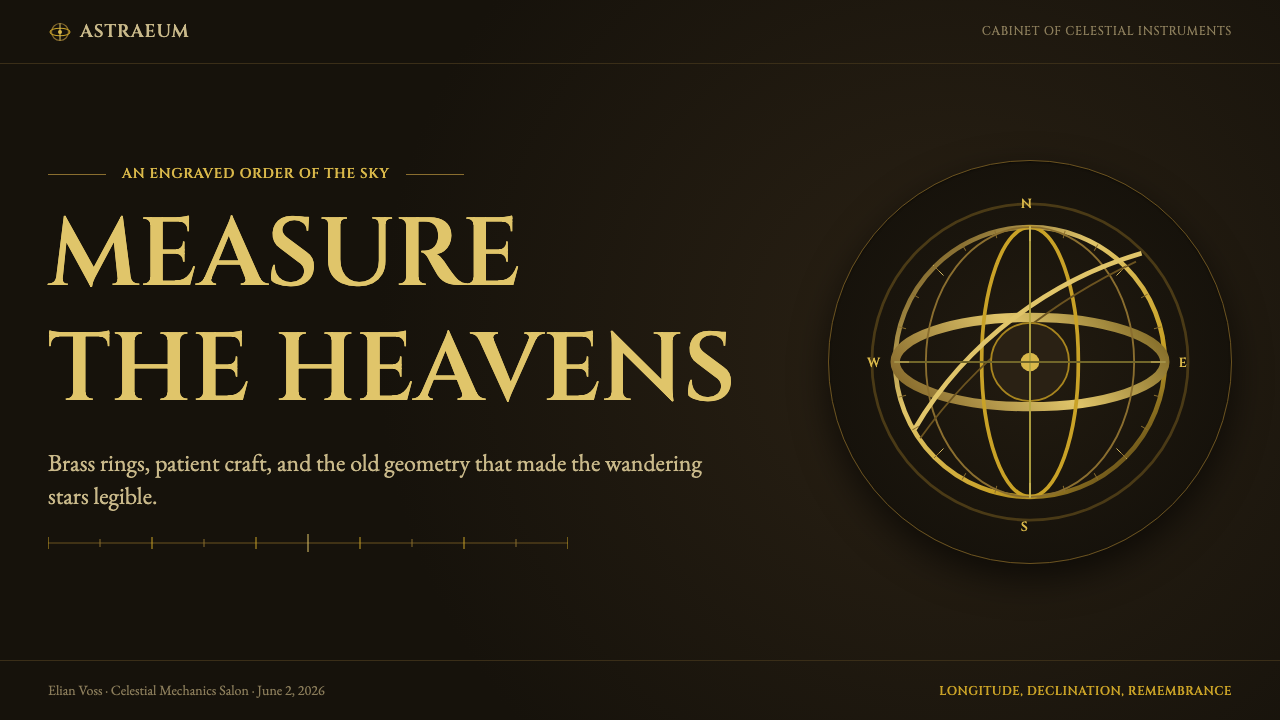
For presentation slides, a cover page benefits from the near-black ground with a single concentric-ring graphic element centered and softly lit, paired with Cinzel-style capital title text. Content slides should keep most of the surface dark, using warm brass or gold sparingly for key figures, headers, or diagrams, and organizing information in concentric or radial layouts where the content allows it, echoing the ring structure of the instrument itself.在演示文稿中,封面页适合以近黑底场搭配一个居中、柔和受光的同心圆环图形元素,再配以Cinzel风格的大写标题文字。内容页应让大部分表面保持暗色,节制地使用温润的黄铜或金色来标示关键数字、标题或图表,并在内容允许的情况下,以同心或放射式的版面来组织信息,呼应这件仪器本身的圆环结构。
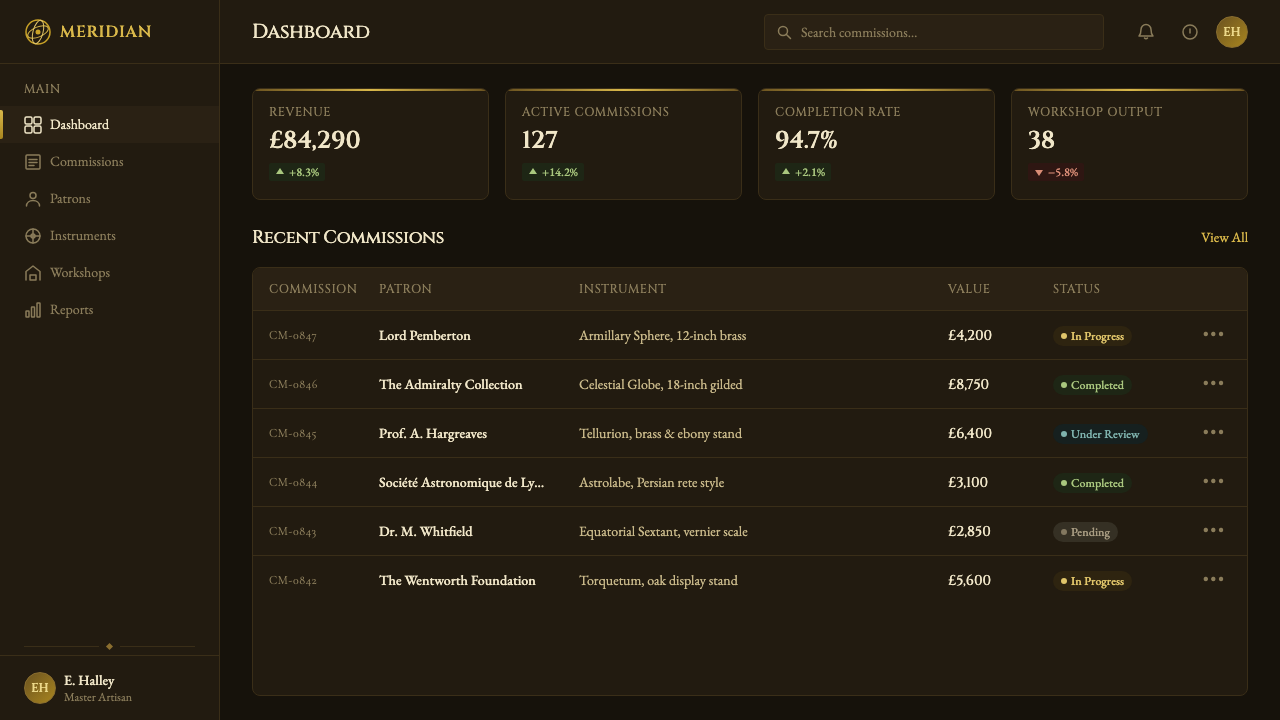
For web interfaces, the style suits premium, intellectually-positioned products — science and education platforms, museum and cultural institution sites, luxury horology or instrument brands, and any product wanting to evoke classical scholarship and precision craft. Dashboards can use concentric-ring visualizations for cyclical or hierarchical data, and interactive elements benefit from a subtle engraved-line texture rather than flat modern fills.在网页界面中,这种风格适合高端、偏智识定位的产品——科学与教育平台、博物馆与文化机构网站、高端钟表或仪器品牌,以及任何想要唤起古典学识与精密工艺感的产品。仪表板可以用同心圆环可视化来呈现周期性或层级性数据,交互元素则受益于一种细微的镌刻线条纹理,而非扁平的现代填充。
For editorial and marketing work, the style suits long-form writing on the history of science, astronomy, or precision instrument-making. Section breaks can use a single ring or arc motif rather than a plain horizontal rule, and photography or illustration should favor the dark, dramatically-lit museum-case aesthetic over bright, evenly-lit product photography.在编辑与营销内容中,这种风格适合关于科学史、天文学或精密仪器制造的长文。段落分隔可以用一道圆环或弧线母题,而非普通的水平分割线,摄影或插画应偏好深色、戏剧化打光的博物馆展柜美学,而非明亮、均匀照明的产品摄影。
A common mistake is treating this style as simply "gold on black," which loses the specific concentric-ring structure and engraved-line quality that give it historical grounding. Another mistake is lighting the entire composition evenly, which flattens the selective glow that makes the brass read as celestial and precious rather than as a generic metallic surface.一个常见的错误,是把这种风格简单理解为「黑底配金色」,这会失去赋予其历史根基的具体同心圆环结构与镌刻线条质感。另一个常见的错误,是将整个构图均匀打光,这会抹平让黄铜读起来像天体般珍贵、而非泛泛金属表面的那种选择性发光。
See the Armillary Sphere design system查看 Armillary Sphere 完整设计系统
Armillary Sphere — FAQArmillary Sphere · 常见问题
Why does this style use a dark background instead of the bright ground more common in scientific diagrams?为什么这种风格使用暗色背景,而非科学图解中更常见的明亮底色?
This style draws specifically on the convention of museum display cases, where armillary spheres and similar instruments are typically shown against deliberately dim, near-black lighting to protect delicate artifacts and to focus attention entirely on the object. A bright neutral ground, by contrast, is the convention of technical or educational diagrams, which serve a different purpose — clarity of measurement rather than reverent display.这种风格具体借鉴的,是博物馆展柜的惯例——浑天仪及类似仪器通常被置于刻意昏暗、近乎全黑的照明之下展示,既为保护精细的文物,也为将注意力完全集中在物件本身。相比之下,明亮的中性底色是技术或教育图解的惯例,它们服务于不同的目的——测量的清晰度,而非崇敬式的展示。
Is the armillary sphere still used for actual astronomy today?浑天仪如今还被用于实际的天文学吗?
No — telescopic astronomy made the armillary sphere obsolete as a working scientific instrument by the seventeenth and eighteenth centuries. It survives today primarily as a museum artifact, a historical teaching object, and a decorative or craft item prized for its visual elegance and its symbolic association with the history of astronomy, rather than as an active measurement tool.不再是——望远镜天文学到十七、十八世纪就已使浑天仪作为实用科学仪器被淘汰。它如今存续下来,主要是作为博物馆文物、历史教学用具,以及因其视觉优雅与同天文学历史的象征性关联而受珍视的装饰品或工艺品,而非一件仍在使用的测量工具。
What is the significance of Cinzel typography in this system?Cinzel字体在这套体系中有什么意义?
Cinzel is a modern typeface modeled directly on classical Roman inscriptional capitals — the kind of lettering carved into ancient monuments and columns. Using it ties the design system's typography to the same deep historical lineage as the instrument itself, which traces back through Renaissance craft to Greek and Roman antiquity, reinforcing the sense of classical scholarship the style depends on.Cinzel是一款直接以古典罗马铭刻大写字母为模板的现代字体——那种镌刻在古代纪念碑与石柱上的字体。使用它,将这套设计体系的字体排印,系于与仪器本身同样深厚的历史渊源之上——经文艺复兴工艺一路追溯至希腊罗马古典时代,强化了这种风格所依赖的古典学识感。
How is this different from generic "steampunk brass" aesthetics?这与泛泛的「蒸汽朋克黄铜」美学有什么不同?
Steampunk brass aesthetics typically borrow mechanical, industrial imagery — gears, pressure valves, riveted machinery — evoking an alternate industrial-age fantasy. This style is specifically astronomical and museum-derived: concentric rings representing actual celestial reference planes, classical Roman typography, and a display convention borrowed from scientific museum cases rather than industrial machine aesthetics. The reference point is precision scientific instrument-making, not steam-powered machinery.蒸汽朋克黄铜美学通常借用机械化、工业化的意象——齿轮、压力阀、铆接的机械——唤起一种架空的工业时代幻想。这种风格则具体是天文学与博物馆本位的:同心圆环代表实际的天球参照平面,古典罗马字体,以及一种借自科学博物馆展柜、而非工业机械美学的陈列惯例。它的参照点是精密科学仪器制造,而非蒸汽动力机械。
Related design styles相关设计风格
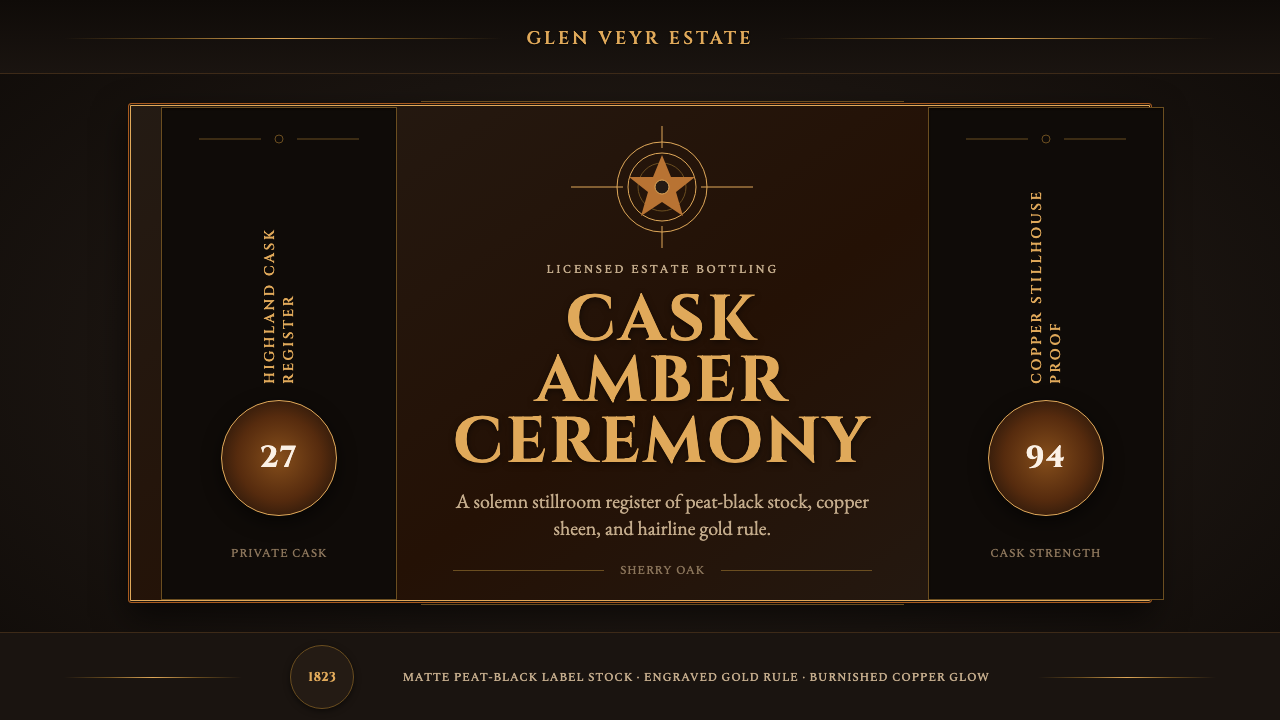 Single Malt ScotchSolemn amber gravity. Thin gold rules and Cinzel capitals glow on peat-black.庄重的琥珀引力。泥煤黑上金线与Cinzel大写发光。
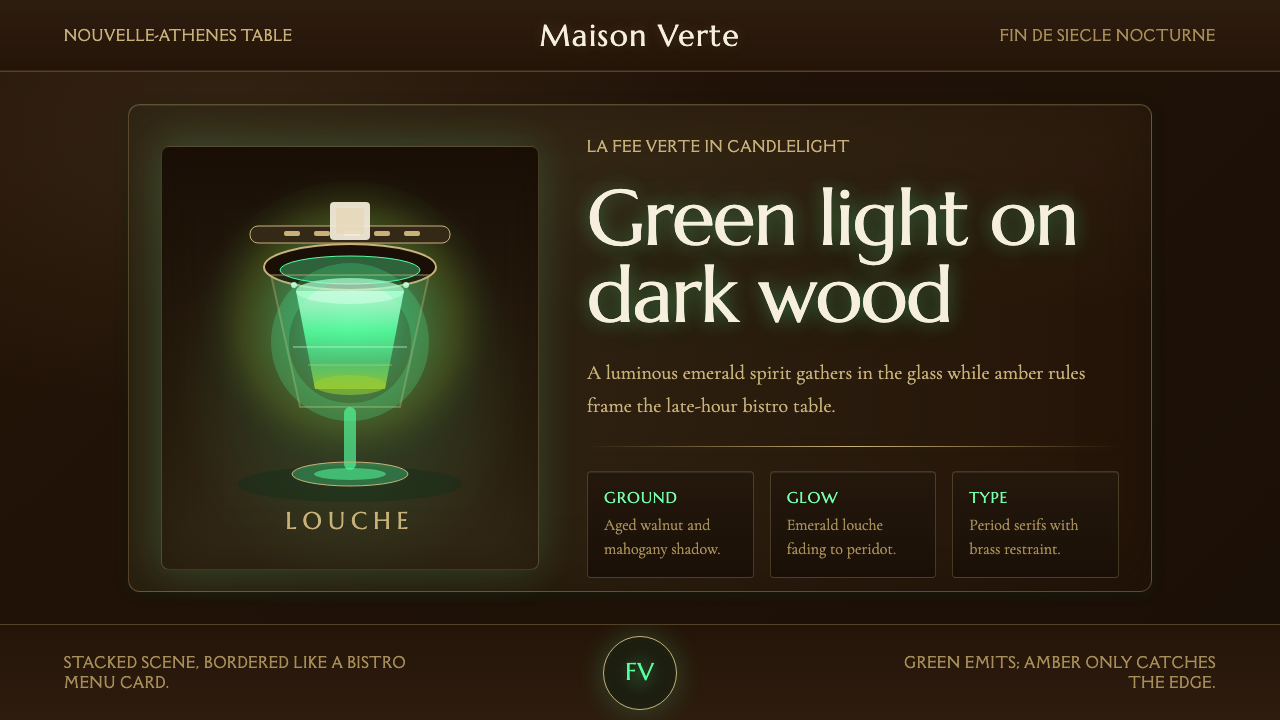 Absinthe Green Fairy GlowDarkness makes the fairy glow. Emerald louche on mahogany, framed by amber se…黑暗托起绿仙微光。桃花心木上翠绿乳浊,琥珀衬线收边。
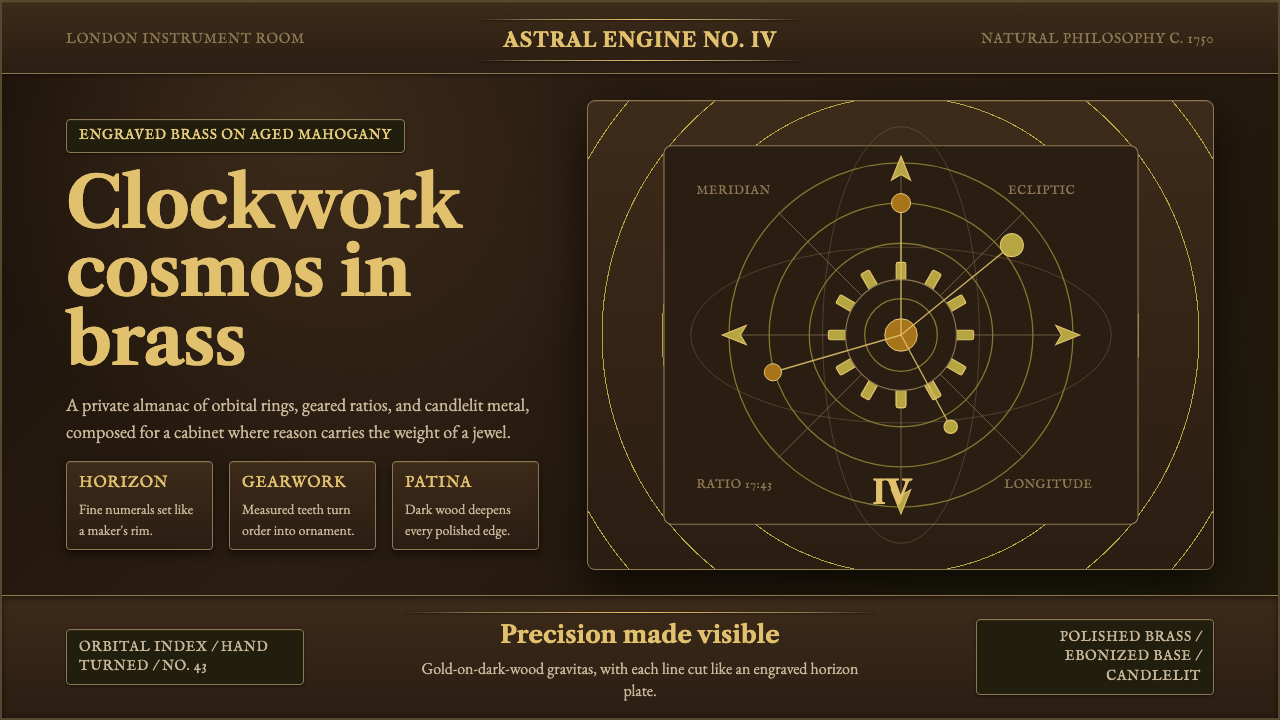 Brass OrreryTurns reason into gold. Brass rings and Caslon type glow over near-black maho…理性化作金色宇宙。黄铜轨环与卡斯隆字体在深桃花心木上发光。
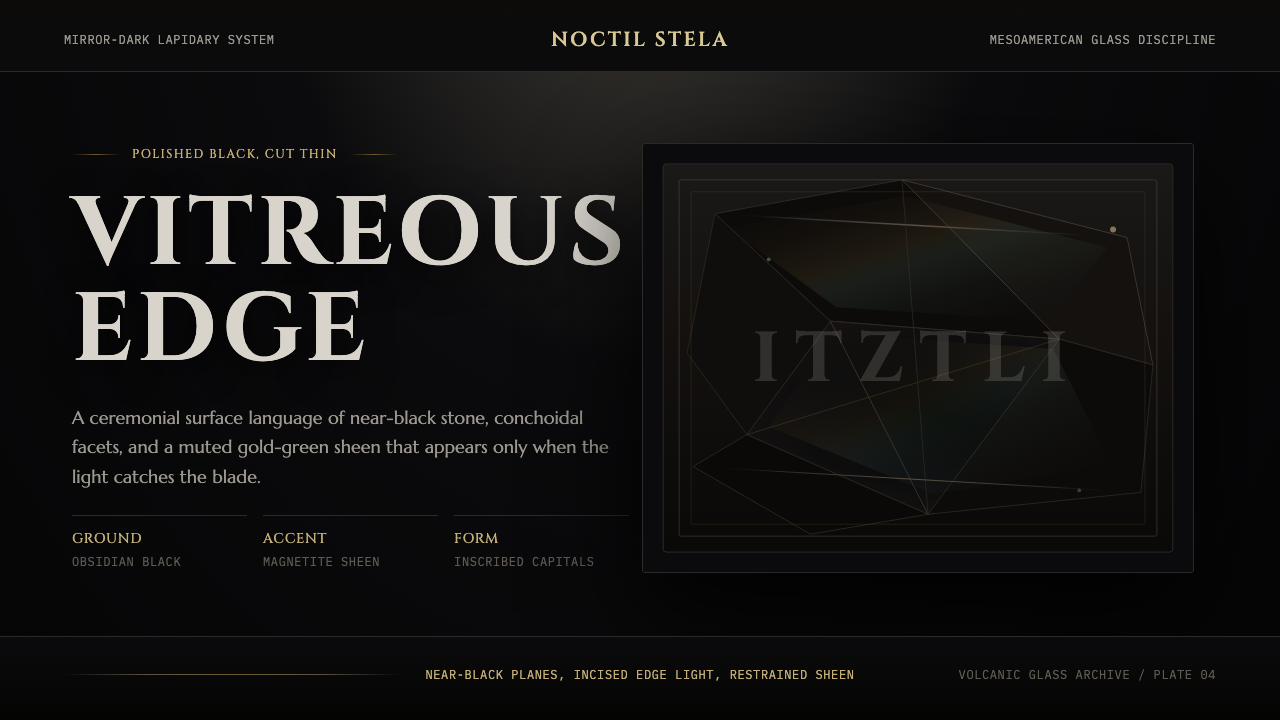 Obsidian Volcanic GlassMirror-dark gravitas. Cinzel capitals, obsidian facets, and muted gold-green…镜黑而庄重。Cinzel 铭文体、黑曜石切面与暗金绿微光。
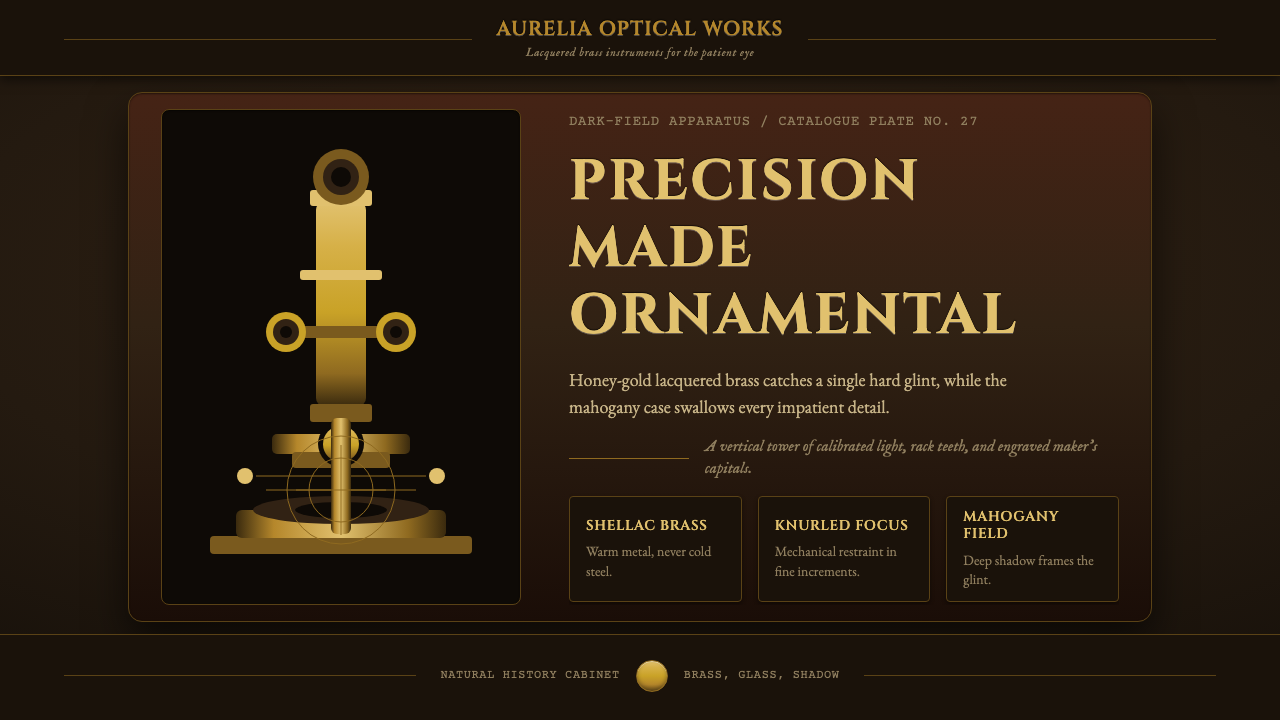 Victorian Brass MicroscopePrecision glows in shadow. Honey brass geometry rises from a mahogany dark-fi…暗场中闪出精密:蜜金黄铜几何立于桃花心木深影。
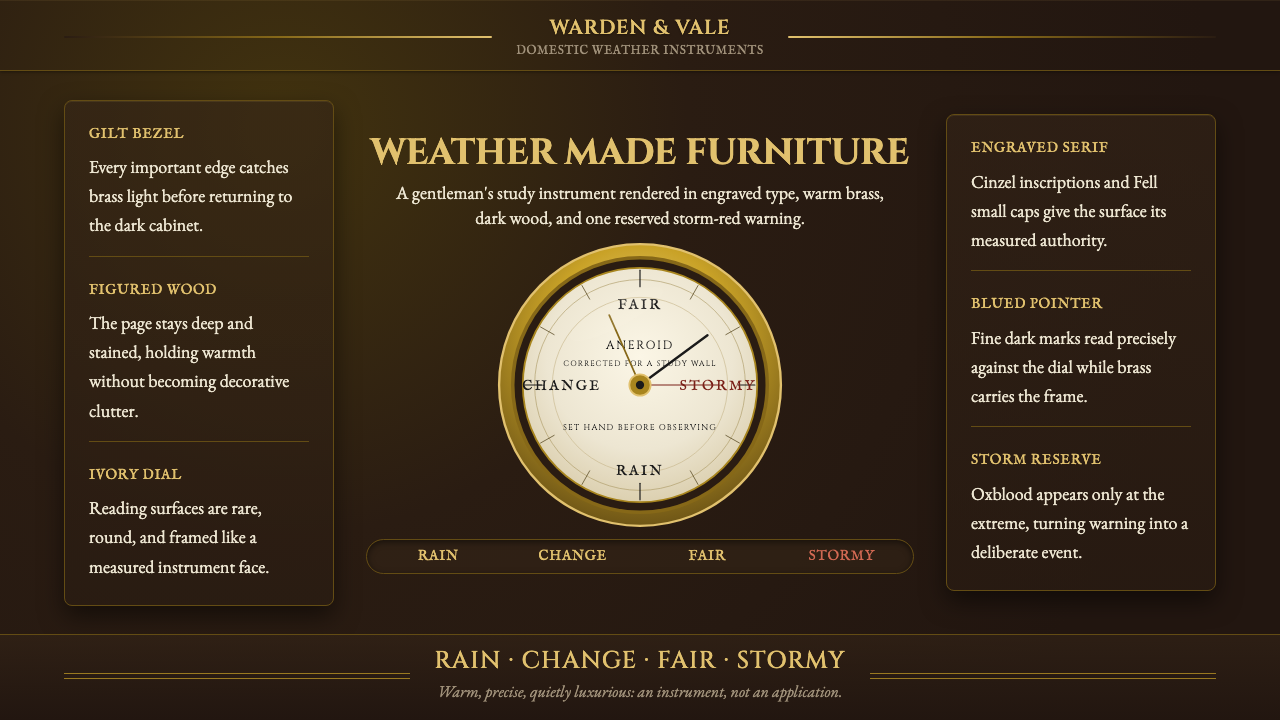 Aneroid BarometerMeasures weather as furniture. Gilt rings and Cinzel engraving glow on dark w…把天气量成家具:深木底、黄铜圈与Cinzel雕刻发光。