What is Algerian M'zab Tilework?什么是 Algerian M'zab Tilework?
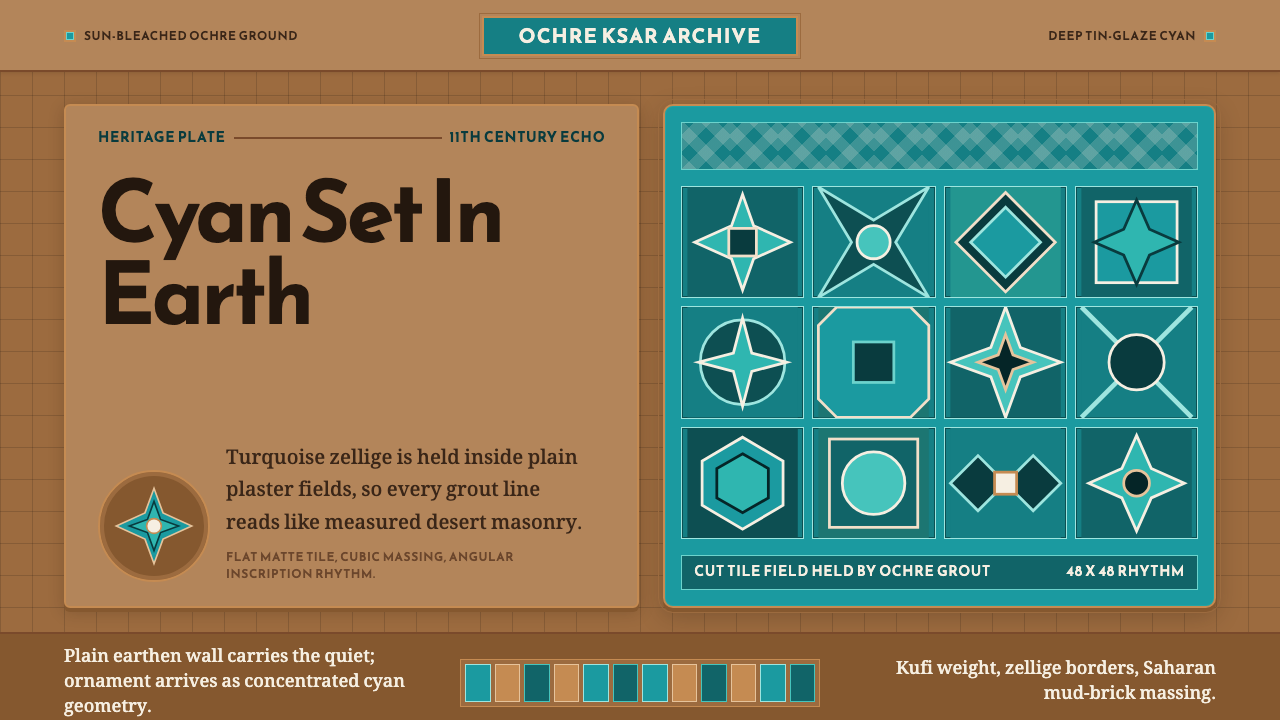
In the M'zab valley, turquoise tile burns against sun-baked ochre earth — a desert color logic built from mineral glaze, cubic mud-brick massing, and angular Kufic script.在姆扎卜河谷,青绿瓷砖在烈日炙烤的赭色大地上灼然燃烧——一套由矿物釉彩、立方土坯体块与棱角库法文字构成的沙漠色彩逻辑。
Algerian M'zab Tilework in briefAlgerian M'zab Tilework 速览
Algerian M'zab Tilework is a design system distilled from the fortified oasis towns of the M'zab valley in the northern Algerian Sahara, where deep teal-turquoise glazed tile is set into pale ochre and pink mud-brick architecture. The style's entire identity rests on a single, uncompromising contrast: saturated cyan-to-peacock tile fields against a ground that is always warm, dry, sun-bleached earth — never a neutral cream, never a cool white.阿尔及利亚姆扎卜瓷砖风格提炼自阿尔及利亚撒哈拉北部姆扎卜河谷的要塞绿洲城镇——那里,深青绿釉面瓷砖被嵌入淡赭与粉色的土坯建筑之中。这套风格的全部身份,建立在一种毫不妥协的对比之上:饱和的青绿到孔雀绿瓷砖面,对撞永远温暖、干燥、被烈日漂白的大地底色——从不是中性的奶白,也从不是冷调的纯白。
Unlike design languages built around a wide palette, this one is disciplined almost to the point of austerity. Two temperatures do all the work: the mineral coolness of glazed turquoise and the mineral warmth of baked clay. Between them sits a network of crisp grout lines that behave like structure rather than decoration — every tile edge is a hard, deliberate seam, never a soft gradient or blur.与那些依赖宽阔色板的设计语言不同,这套体系近乎苦行般克制。仅靠两种温度就完成了全部工作:釉面青绿的矿物冷感,与烘烤陶土的矿物暖感。二者之间,是一整张利落的灰缝线网络——它们的作用更像结构而非装饰,每一条瓷砖边缘都是硬朗、刻意的接缝,从不是柔和的渐变或模糊。
The typographic voice matches the architecture: angular, upright, monumental. Kufic-derived lettering — the oldest formal script tradition in Arabic calligraphy, built from straight strokes and right angles — supplies a geometric seriousness that echoes the cubic stacking of the ksour themselves. The overall effect reads as fortified, arid, and precise: a desert settlement's visual logic translated wholesale into a digital surface.字体的声音与建筑相呼应:棱角分明、挺直、纪念碑式。源自库法体的字形——阿拉伯书法传统中最古老的正式字体,由直线笔画与直角构成——赋予了一种几何上的庄重感,呼应着古堡本身立方堆叠的体量。整体效果读起来是要塞感的、干旱的、精确的:一座沙漠聚落的视觉逻辑被整体转译进了数字表面。
See the Algerian M'zab Tilework design system查看 Algerian M'zab Tilework 完整设计系统
Where does Algerian M'zab Tilework come from?Algerian M'zab Tilework 从何而来?
The M'zab valley lies in the northern Sahara around Ghardaïa, roughly 600 kilometers south of Algiers, where a community of Ibadi Berbers — followers of a distinct, austere branch of Islam that split from both Sunni and Shia traditions in the seventh century — sought refuge from persecution beginning in the eleventh century. Faced with a harsh, waterless plateau, they built not one settlement but a pentapolis: five fortified towns (ksour), each crowning a hilltop and each organized as a defensive spiral climbing toward a central mosque whose minaret doubled as both spiritual anchor and watchtower.姆扎卜河谷位于撒哈拉北部的加尔达亚一带,在阿尔及尔以南约六百公里处。自十一世纪起,一支伊巴德派柏柏尔人社群为躲避迫害在此定居——伊巴德派是伊斯兰教一支独特而克己的分支,早在七世纪就从逊尼与什叶两大传统中分离出来。面对严酷无水的高原,他们没有建造单一聚落,而是营造了一个五城邦群:五座要塞城镇(ksar),每座都坐落于山顶,都以防御性螺旋结构层层攀升,直至中央清真寺——其宣礼塔既是精神支柱,也是了望哨。
The valley's most prominent town, Ghardaïa, along with Beni Isguen, El Atteuf, Bou Noura, and Melika, was built almost entirely from local materials: mud brick and gypsum plaster, both abundant in a landscape with almost nothing else to offer. The gypsum plaster, applied in pale ochre, white, and dusty pink, gave the towns their characteristic sun-bleached glow, while the cubic massing of stacked flat-roofed houses, terraced against the slope, created the dense, almost crystalline urban geometry that architects and artists — most famously Le Corbusier, who visited and sketched the valley in the 1930s — would later cite as a formative influence on modernist architecture.河谷中最著名的城镇加尔达亚,连同贝尼伊斯根、埃尔阿图夫、布努拉与梅利卡,几乎全部由本地材料建成:土坯与石膏抹面,二者在这片几乎一无所有的土地上尚算丰饶。石膏抹面涂以淡赭、白与灰粉色,赋予这些城镇标志性的日晒光泽;而层层堆叠、依山势退台的平顶方块住宅,共同形成了密集、近乎晶体般的城市几何——建筑师与艺术家们(其中最著名的是柯布西耶,他在1930年代造访并速写了这座河谷)后来称之为现代主义建筑的重要灵感来源之一。
Into this severe, earth-toned townscape, Mozabite craftsmen introduced a single note of brilliant color: zellige, the North African tradition of hand-cut, tin-glazed mosaic tilework. Unlike the more famously multicolor zellige of Fez or Marrakesh, the M'zab tradition favored a narrower, more disciplined range concentrated in deep teal and turquoise — a color chosen partly for its availability in local glaze chemistry and partly for the way it visually cooled and punctuated the relentless heat of the surrounding ochre walls. This tile appeared at doorways, courtyard fountains, prayer niches, and public squares, always as a deliberate accent rather than a blanket covering.在这片严峻、土色调的城镇景观中,姆扎卜工匠引入了唯一一抹绚烂色彩:镶嵌瓷砖(zellige),北非手工切割、锡釉马赛克的传统工艺。与更为知名的、色彩斑斓的非斯或马拉喀什镶嵌瓷砖不同,姆扎卜的传统偏爱更窄、更克制的色域,集中于深青绿到绿松石之间——这一选择部分源于当地釉料化学的可得性,部分则出于它能从视觉上冷却并点亮四周无休止的赭色墙面。这类瓷砖出现在门廊、庭院喷泉、祈祷壁龛与公共广场,始终是刻意的点缀,而非通体覆盖。
The tradition of Mozabite craft guilds, particularly those of Beni Isguen — a town so protective of its integrity that non-residents were historically barred from staying overnight — preserved these building and tiling techniques through strict apprenticeship and communal oversight for nearly a millennium, with remarkably little stylistic drift. UNESCO inscribed the M'zab valley as a World Heritage Site in 1982, citing it as an exceptional example of a still-inhabited traditional human settlement in perfect harmony with its environment, and the valley's stark cyan-on-ochre visual identity has since become a recognizable reference point in discussions of vernacular North African design.姆扎卜工匠行会的传统——尤其是贝尼伊斯根的行会(这座城镇历史上甚至禁止非居民留宿过夜,以此守护自身的完整性)——通过严格的学徒制与社群监督,将这些建造与镶嵌工艺近乎原样地传承了近千年,风格漂移极小。1982年,联合国教科文组织将姆扎卜河谷列为世界遗产,称其为至今仍有人居住、与自然环境完美和谐的传统人类聚落的杰出范例;此后,这座河谷青绿对赭土的鲜明视觉身份,已成为讨论北非乡土设计时一个公认的参照坐标。
What defines the Algerian M'zab Tilework look?Algerian M'zab Tilework 的视觉特征是什么?
Color色彩
The palette is a strict two-temperature system: saturated turquoise-to-peacock cyan for tile fields, and warm, sun-bleached ochre earth for grounds. There is no neutral middle ground — no cream, no gray-beige compromise. Where a secondary accent appears, it leans toward a dusty pink or warm white plaster tone, never a cool white.色板是一套严格的双温度体系:饱和的青绿到孔雀绿用于瓷砖面,温暖、被日晒漂白的赭土色用于底面。二者之间没有中性的折中地带——没有奶白,没有灰米色的妥协。若出现次级点缀色,也会偏向尘粉色或暖白灰泥色调,绝不取冷白。
Typography字体排印
Lettering draws on Kufic script logic: upright strokes, right angles, and a geometric, monumental bearing rather than flowing curves. Even where Latin characters are used, the letterforms should carry the same squared, architectural discipline — angular rather than rounded terminals, deliberate rather than casual proportions.字体借鉴库法体的书写逻辑:挺直的笔画、直角转折,以几何化、纪念碑式的气度取代流畅的曲线。即便使用拉丁字符,字形也应保持同样方正、建筑化的自律——收笔是棱角而非圆润,比例是刻意而非随性的。
Tile Grid and Grout瓷砖网格与灰缝
Turquoise tile fields are never rendered as a flat color wash — they are built from a visible grid of individual tiles separated by crisp, hard grout lines. This grid can be regular and orthogonal, echoing zellige geometry, and the grout line itself functions as a structural device that organizes content, not merely a texture applied for flavor.青绿瓷砖面绝不以纯色平涂呈现——它们由一张清晰可见的瓷砖网格构成,块与块之间以利落、硬朗的灰缝分隔。这张网格可以是规则的、正交的,呼应镶嵌瓷砖的几何逻辑,而灰缝线本身充当一种组织内容的结构装置,而非仅仅是为增添质感而叠加的纹理。
Cubic Massing立方体块感
Compositions favor stacked, blocky rectangular forms over organic or curved shapes, mirroring the terraced cube geometry of the ksour themselves. Panels and containers read as solid architectural volumes rather than floating cards — flush edges, minimal rounding, and a sense of weight and permanence.构图偏爱堆叠、方块状的矩形形态,而非有机或曲线形状,呼应古堡本身层层退台的立方几何。面板与容器读起来像是坚实的建筑体量,而非漂浮的卡片——齐平的边缘、极简的圆角,以及一种重量感与恒久感。
Angular Ornament棱角装饰
Where ornament appears, it is geometric and angular — cross-hatched or stepped motifs rather than floral or curvilinear arabesque. This distinguishes the M'zab visual tradition from the more ornate, curvilinear zellige work of imperial Moroccan cities, keeping the overall feel severe and desert-hardened rather than opulent.若出现装饰纹样,也是几何化、棱角分明的——交叉排线或阶梯状母题,而非花卉或曲线的阿拉伯式蔓草纹。这使姆扎卜的视觉传统区别于摩洛哥帝国城市那更为华丽、曲线繁复的镶嵌瓷砖工艺,让整体气质保持严峻、经沙漠磨砺,而非奢华繁复。
Hard Light and Shadow硬光与投影
Shadows are treated as hard-edged and high-contrast, evoking the unfiltered desert sun striking cubic mud-brick walls. There is no soft ambient diffusion — light and shade are two flat states with a crisp boundary between them, matching the way sunlight carves sharp geometry onto the ksour's terraced surfaces.阴影处理为硬边、高对比,唤起未经滤镜的沙漠烈日打在立方土坯墙面上的效果。没有柔和的环境漫射——光与影是两种平面状态,中间有一道利落的分界线,正如阳光在古堡层叠的表面上刻画出锐利的几何形。
Texture as Structure作为结构的质感
Surface texture — the grain of mud brick, the crackle of gypsum plaster, the slight irregularity of hand-cut tile — is present but always subordinate to the underlying geometric grid. Texture adds age and hand-craft without ever softening the hard edges that define the style's tile-and-earth logic.表面质感——土坯的颗粒感、石膏抹面的龟裂纹、手工切割瓷砖的些许不规则——始终存在,但始终从属于底层的几何网格。质感增添了年代感与手工感,却从不软化定义这套瓷砖与大地逻辑的硬朗边缘。
See the Algerian M'zab Tilework design system查看 Algerian M'zab Tilework 完整设计系统
Who shaped Algerian M'zab Tilework?谁塑造了 Algerian M'zab Tilework?
Anonymous, generationally trained craftsmen who developed and preserved the M'zab valley's distinctive teal-turquoise zellige tradition. Their work concentrated color into deliberate accents — doorways, fountains, prayer niches — rather than blanket coverage, a restraint that became the defining logic of the style.无名而世代传承的工匠群体,发展并守护了姆扎卜河谷独树一帜的青绿镶嵌瓷砖传统。他们的作品将色彩凝聚为刻意的点缀——门廊、喷泉、祈祷壁龛——而非通体覆盖,这种克制成为这套风格的核心逻辑。
The generations of builders who raised Ghardaïa and its four sister towns as defensive hilltop spirals of stacked mud-brick cubes. Their terraced, cubic urban geometry — later admired by modernist architects — supplies the blocky massing principle at the heart of this design system.建起加尔达亚及其四座姊妹城镇的世代建造者,将其营造为堆叠土坯方块构成的防御性山顶螺旋聚落。他们那层叠、方块化的城市几何——后来受到现代主义建筑师的推崇——为这套设计系统提供了核心的方块体量原则。
The most protective and insular of the M'zab's five towns, Beni Isguen maintained closed craft guilds that preserved tile-setting and plastering techniques through strict apprenticeship, guarding against outside stylistic influence and keeping the tradition remarkably stable across centuries.作为姆扎卜五城中最具保护意识与内向性的城镇,贝尼伊斯根维持着封闭的手工艺行会,通过严格的学徒制度守护镶嵌与抹灰技艺,抵御外来风格的渗入,使这一传统历经数百年仍保持惊人的稳定。
How do you use Algerian M'zab Tilework today?今天怎么用 Algerian M'zab Tilework?
Because the style's entire logic rests on a strict two-temperature contrast, applying it correctly starts with discipline: pick one saturated turquoise and one warm ochre earth tone and let everything else derive from them, rather than reaching for a broader decorative palette.由于这套风格的全部逻辑都建立在严格的双温度对比之上,正确应用它的第一步是自律:选定一种饱和青绿与一种暖赭土色,让其余一切都从这两者衍生,而不是伸手去取更宽泛的装饰色板。
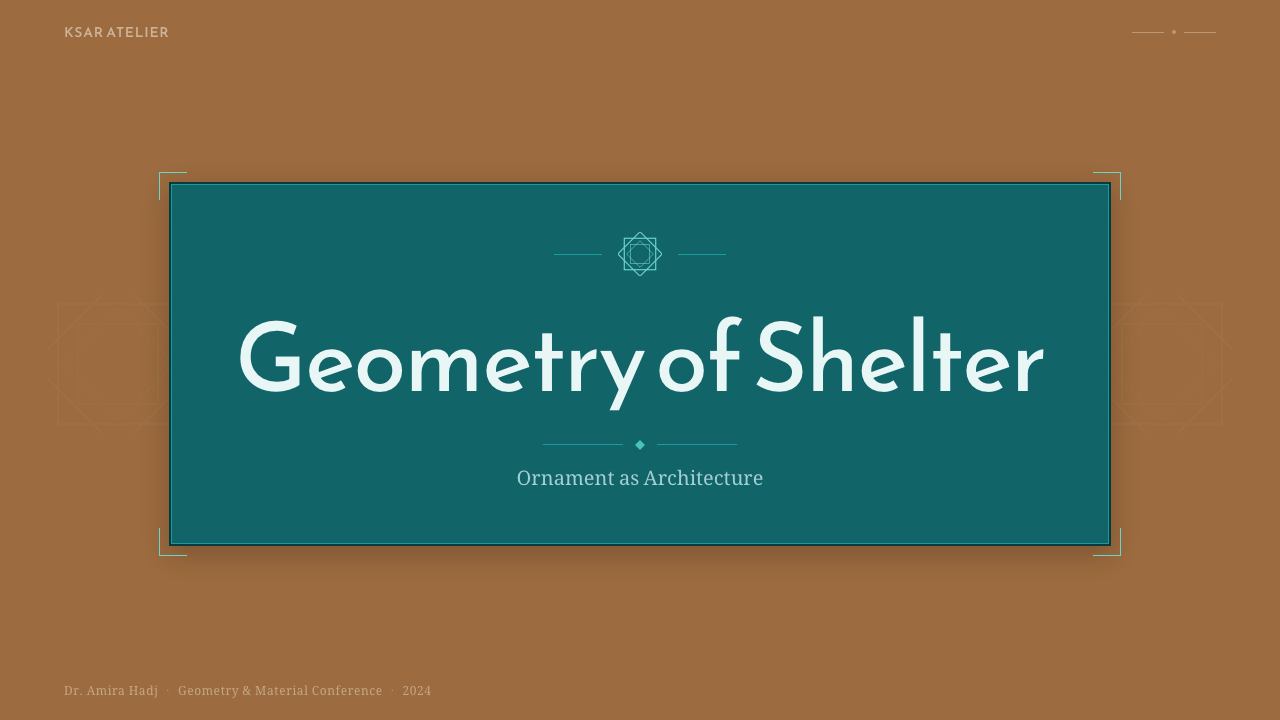
For presentation slides, this style makes a striking cover treatment: a large turquoise tile-grid panel occupying one edge of the frame against an ochre-earth field, with angular Kufic-inspired title type set in high contrast. Content slides work best as stacked, blocky panels — cubic massing rather than floating rounded cards — with data visualized as flat geometric blocks rather than soft gradient charts.在演示文稿中,这种风格适合做出令人印象深刻的封面处理:一大块青绿瓷砖网格面板占据画面一侧,对撞赭土色底面,标题以棱角分明、库法体风格的字形高对比呈现。内容页最适合处理成堆叠的方块面板——立方体块感而非漂浮的圆角卡片——数据以平面几何色块而非柔和渐变图表来呈现。
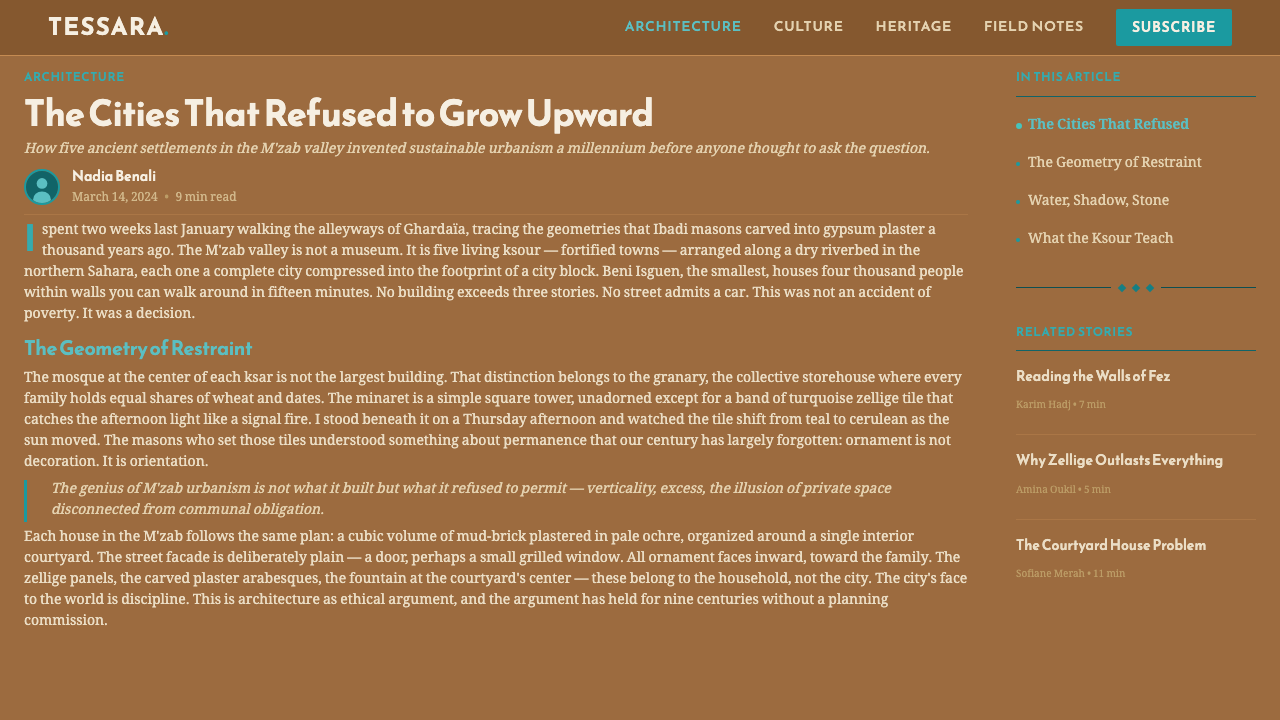
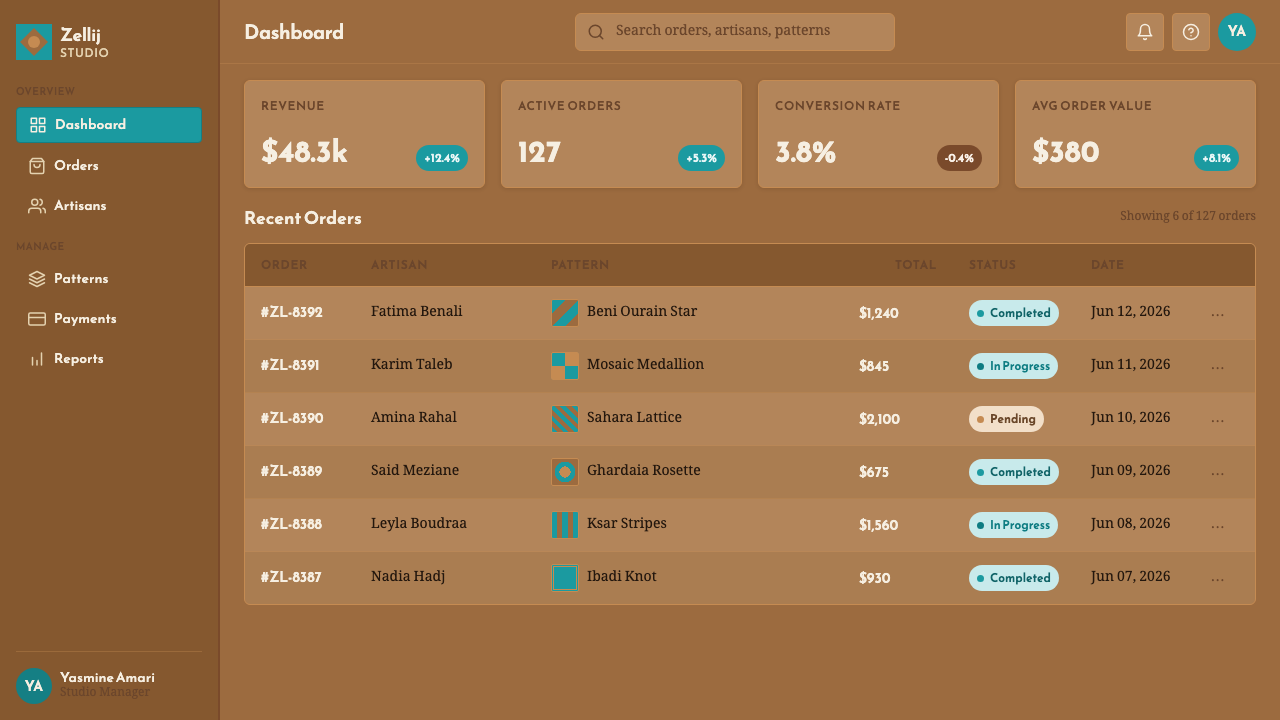
For web interfaces, the tile-grid motif translates naturally into card borders, section dividers, and hero backgrounds — a visible grid of turquoise tile with crisp grout lines can frame a dashboard header or pricing table without overwhelming the content beneath it. Interactive states can borrow the doorway-accent logic of the original architecture: turquoise reserved for buttons, active tabs, and highlights, while the bulk of the interface remains warm and earthen.对于网页界面,瓷砖网格母题能自然转化为卡片边框、分隔线与主视觉背景——一片可见的、以利落灰缝分隔的青绿瓷砖网格,可以为仪表板头部或定价表提供画框,而不会压过下方内容。交互状态可以借用原始建筑中门廊点缀的逻辑:青绿只保留给按钮、当前标签与高亮区域,界面主体则保持温暖的土色调。
For editorial and marketing contexts, the style rewards restraint in imagery — a single strong turquoise accent block against a large field of warm neutral earth reads as confident and considered, echoing the way Mozabite builders concentrated color into a single deliberate note rather than spreading it evenly. Full-bleed sections can alternate between ochre-dominant and turquoise-dominant blocks to create rhythm without introducing new hues.对于编辑与营销场景,这种风格在图像运用上偏好克制——一整块强烈的青绿点缀区,对撞大面积温暖中性的土色底面,读起来自信而深思熟虑,呼应姆扎卜工匠将色彩凝聚为一处刻意音符、而非均匀铺开的做法。通栏区块可以在赭土主导与青绿主导之间交替,制造节奏感,而无需引入新的色相。
A common mistake is softening the ground toward cream or gray-beige, which erodes the desert-heat contrast that makes the style legible. Another is treating the turquoise as a flat color fill rather than a visible tile grid — without the grout-line structure, the reference to zellige craftsmanship disappears and the palette reads as generic teal-and-tan rather than M'zab specifically.一个常见的错误,是把底色软化为奶白或灰米色,这会侵蚀让这套风格得以辨识的沙漠烈日对比感。另一个错误,是把青绿处理成纯色平涂,而非可见的瓷砖网格——缺了灰缝线的结构,对镶嵌工艺的指涉就消失了,色板会读成泛泛的青褐配色,而不再具体指向姆扎卜。
See the Algerian M'zab Tilework design system查看 Algerian M'zab Tilework 完整设计系统
Algerian M'zab Tilework — FAQAlgerian M'zab Tilework · 常见问题
Why is the ground always ochre earth and never cream or white?为什么底色永远是赭土色,从不是奶白或纯白?
Because the entire visual logic of the style depends on the contrast between cool turquoise glaze and warm, sun-baked earth — a contrast drawn directly from the M'zab valley's mud-brick architecture. A cream or white ground flattens that temperature difference and makes the style read as generic teal-and-neutral rather than specifically desert-vernacular. Keeping the ground saturated and warm is what signals 'this is earth, not paper'.因为这套风格的全部视觉逻辑,都依赖于冷调青绿釉彩与温暖、被烈日烘烤的大地之间的对比——这种对比直接取自姆扎卜河谷的土坯建筑。奶白或纯白底色会抹平这种温度差异,让风格读起来像泛泛的青褐加中性色,而不再特指沙漠乡土建筑。保持底色饱和而温暖,正是在传达'这是大地,不是纸张'。
Is this the same as Moroccan zellige tilework?这和摩洛哥的镶嵌瓷砖工艺是同一回事吗?
Related but distinct. Both trace to the broader North African tin-glaze mosaic tradition, but Moroccan zellige — as seen in Fez or Marrakesh — typically uses a wider, more multicolor palette and more curvilinear, floral ornament. The M'zab tradition is narrower and more disciplined: concentrated in deep teal-turquoise, set against warm earth rather than white or cream, and paired with angular rather than curvilinear ornament, reflecting the austere Ibadi Berber sensibility of the valley.相关但不同。两者都可以追溯到更广泛的北非锡釉马赛克传统,但摩洛哥的镶嵌瓷砖——如非斯或马拉喀什所见——通常使用更宽、更多彩的色板与更曲线化的花卉纹样。姆扎卜的传统更窄、更克制:色彩集中于深青绿,衬托温暖大地而非白色或奶白,并搭配棱角而非曲线的装饰,反映出河谷伊巴德派柏柏尔人克己的审美感受力。
Can this style work for a light, airy interface, or does it require a dense, heavy feel?这种风格能用于轻盈、通透的界面吗,还是必须是厚重密集的感觉?
The style leans naturally toward density and weight, mirroring the fortified, stacked-cube architecture it draws from — but it can be opened up by increasing the proportion of ochre ground relative to turquoise tile and using the tile grid sparingly, as a framing accent rather than a dominant field. What should not change is the temperature contrast itself; lightening the style means using less turquoise, not cooling the ground.这种风格天然偏向密度与厚重感,呼应其取材的要塞式、堆叠方块建筑——但可以通过提高赭土底色相对于青绿瓷砖的比例、并将瓷砖网格作为点缀性画框而非主导性铺面来使其变得通透。不应改变的是温度对比本身;让风格变轻盈,意味着少用青绿,而不是把底色变冷。
What kind of typography pairs well with the Kufic-inspired lettering?什么样的字体排印能与库法体风格的字形相配?
Geometric sans-serif faces with squared terminals and minimal curvature pair most naturally, since they echo the right-angle discipline of Kufic script without requiring literal Arabic calligraphy. Avoid rounded, soft, or script-like typefaces, which contradict the monumental, architectural bearing that defines the style's lettering.方正收笔、曲率极小的几何无衬线字体最为相配,因为它们呼应了库法体的直角自律,又无需真的使用阿拉伯书法。应避免圆润、柔和或手写体式的字体,它们与定义这套风格字形的纪念碑式建筑气度相悖。
Does this style suit contexts outside architecture and design specimen pages, like a product dashboard?这种风格适合建筑与设计标本页面之外的场景吗,比如产品仪表板?
Yes, as long as the temperature contrast and grid discipline carry over. A dashboard can use ochre-earth as its dominant background, turquoise reserved for key metrics, active states, or alerts, and a visible tile-grid pattern confined to header bands or section dividers rather than covering every surface. The style struggles in contexts demanding a cool, corporate neutrality — its warmth and saturation are assertive rather than quiet.可以,只要温度对比与网格自律得以延续。仪表板可以以赭土色作为主导背景,将青绿保留给关键指标、激活状态或警示信息,并把可见的瓷砖网格图案限制在头部横条或分隔区域,而非覆盖每一处表面。这种风格在需要冷静、企业化中性感的场景中会显得力不从心——它的暖度与饱和度是张扬的,而非安静的。
Related design styles相关设计风格
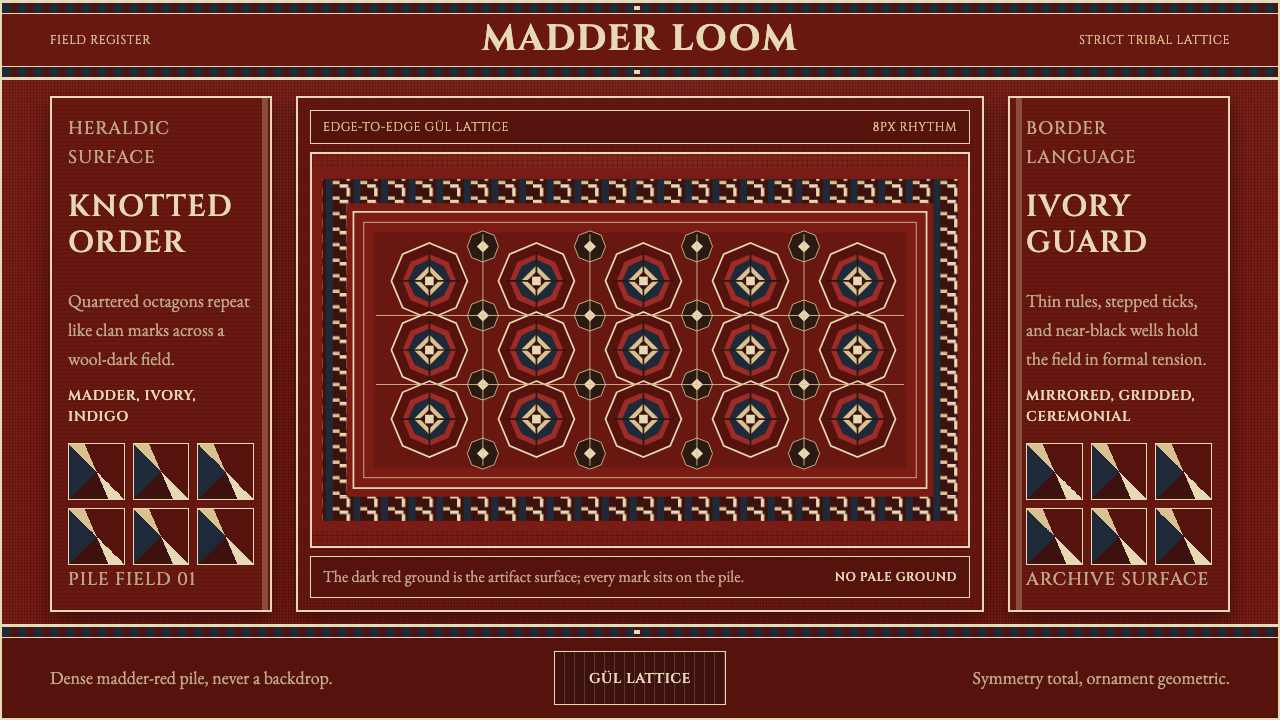 Turkmen Bukhara RugHeraldic and earthbound. Madder red, ivory hairlines, and octagonal güls lock…庄重扎根:茜红绒面、象牙细线与八角古尔纹锁成格律。
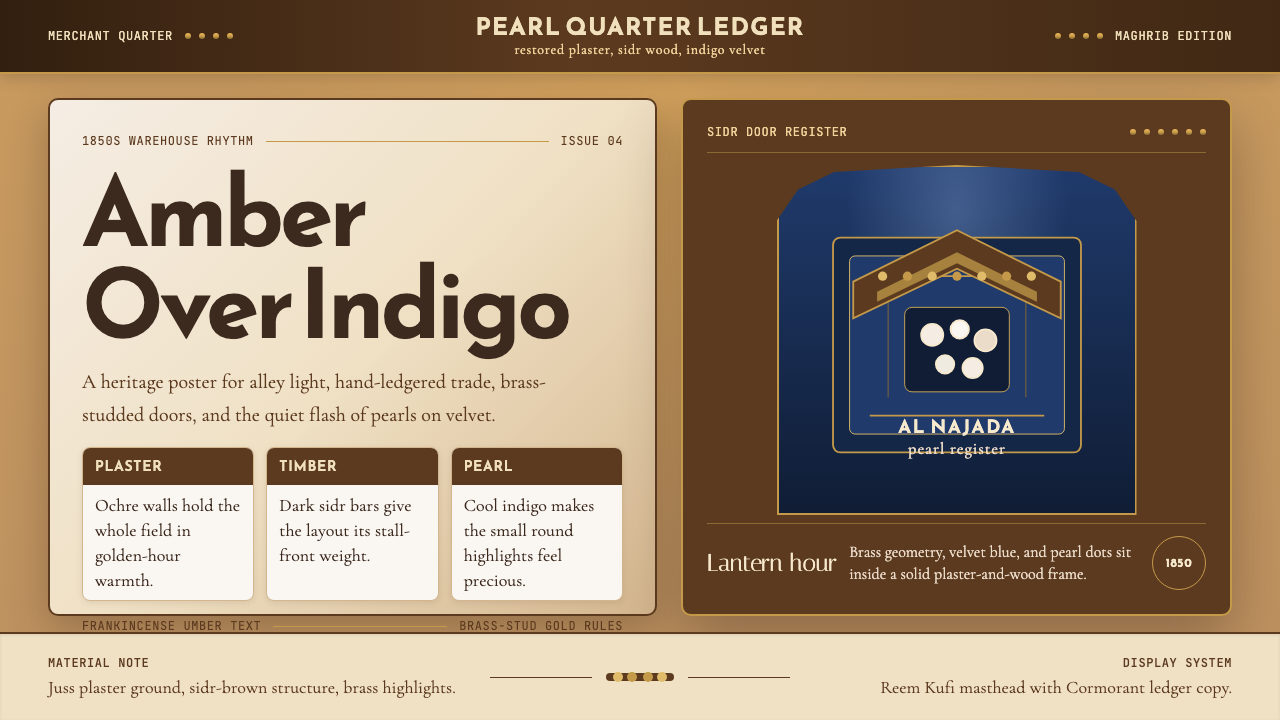 Qatari Souq Waqif Pearl QuarterWarmth has weight. Ochre plaster, sidr-brown bars, indigo velvet, brass geome…温暖有重量。赭石灰泥、棕木横栏、靛蓝丝绒与黄铜几何。
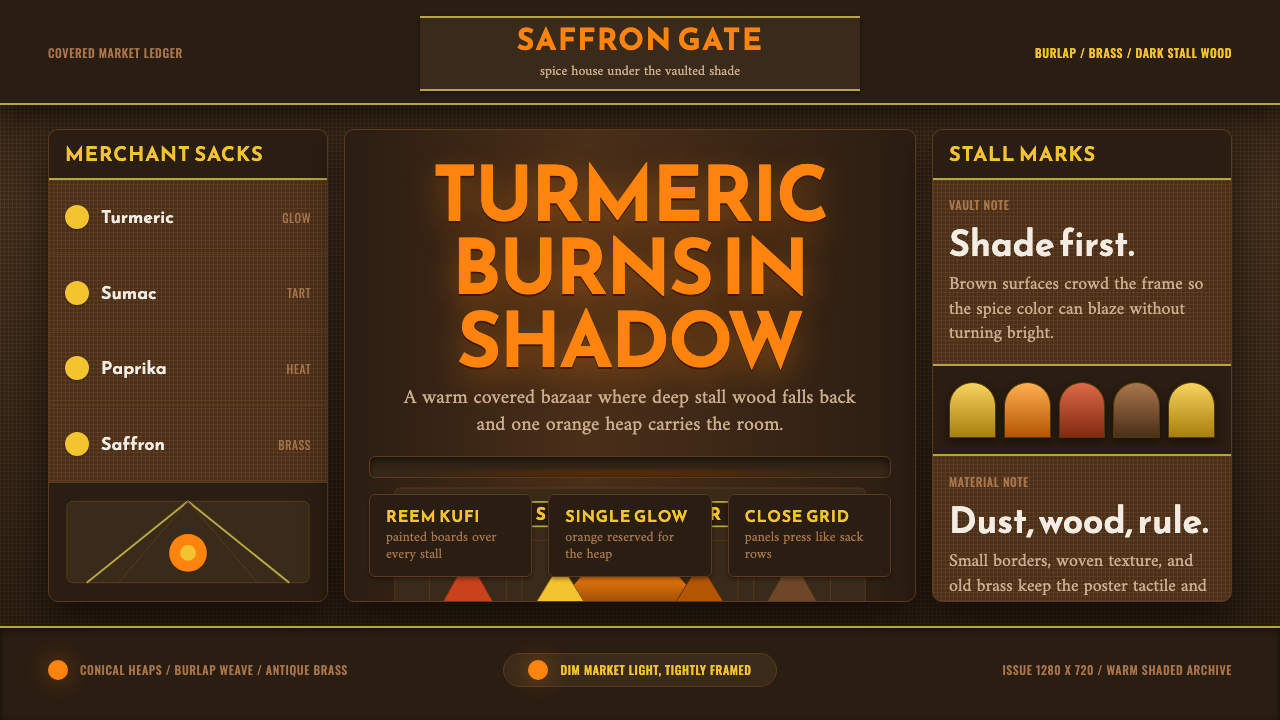 Spice Souk BazaarShade carries the heat. Turmeric orange glows through brown grids and Kufi si…阴影托起热度。姜黄橙穿过深棕网格与库菲招牌发光。
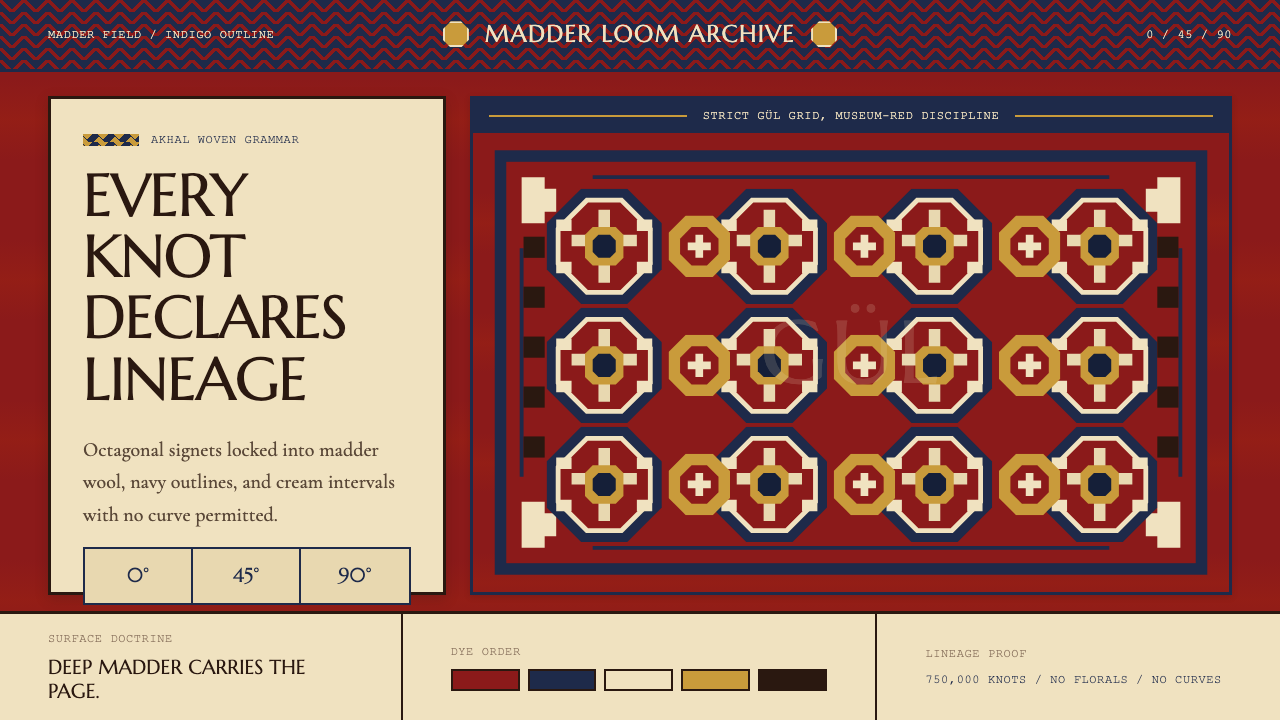 Turkmen Tekke Carpet (Gül Medallion)Disciplined red geometry. Madder field, indigo outlines, cream gül grid.红色几何有纪律。茜草红底、靛蓝线、奶白格尔阵列。
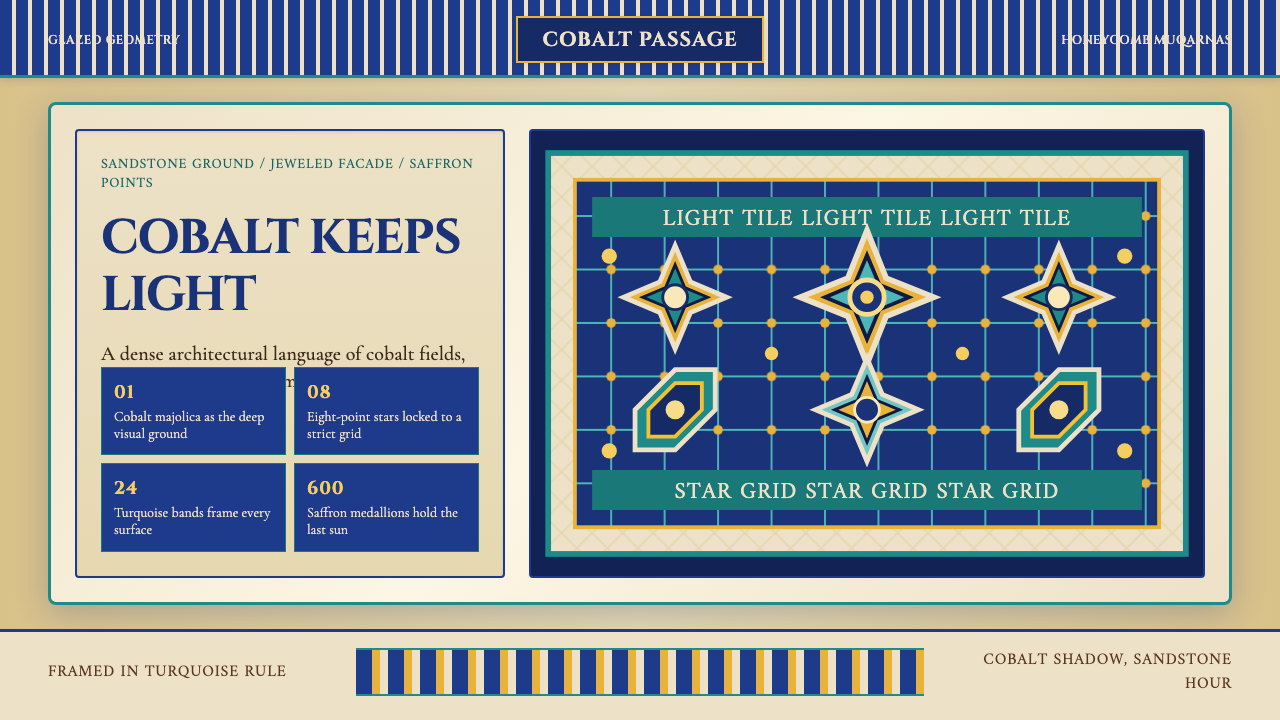 Uzbek Samarkand Shah-i-ZindaOpulent tile memory. Cobalt grids, turquoise bands, and saffron medallions cr…繁密如釉砖记忆。钴蓝网格、绿松石边带与藏红花徽章铺满砂岩底。
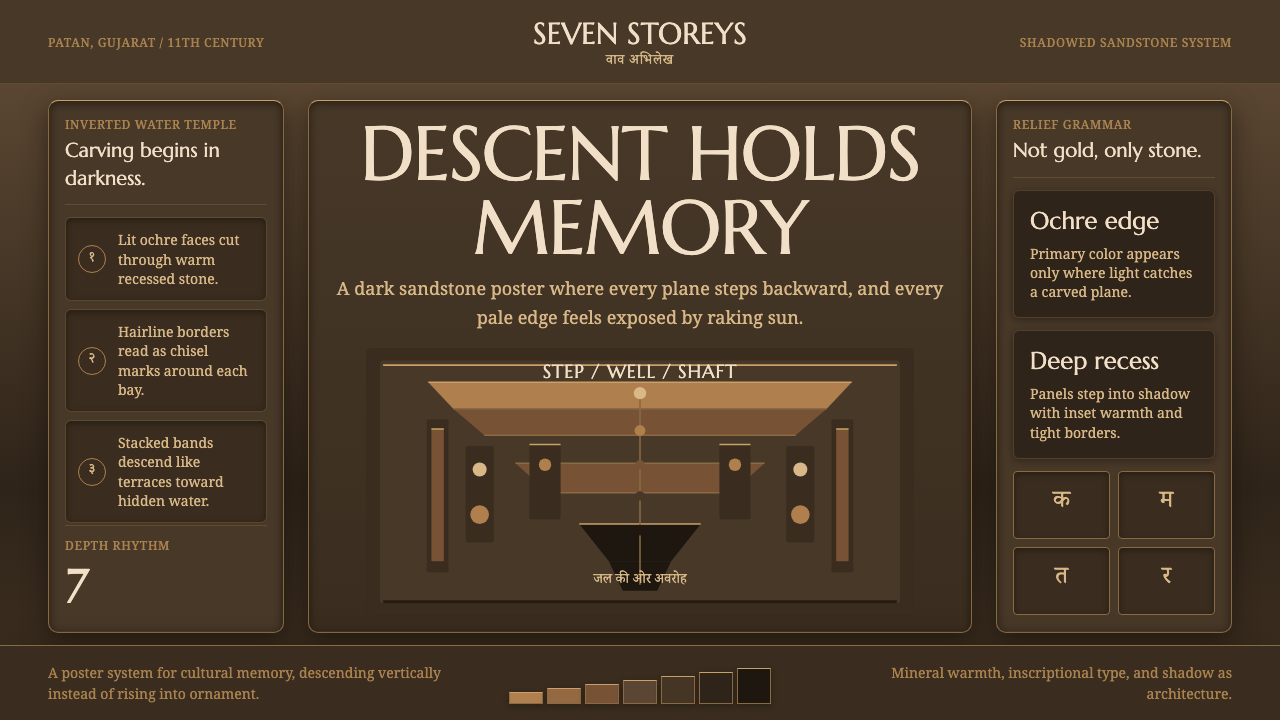 Indian StepwellStone descends into shadow. Ochre serif type and stacked terraces carve the f…砂岩向暗处下沉。赭色衬线与层叠阶台凿出画面。