What is Hashemite Jordan Postage?什么是 Hashemite Jordan Postage?
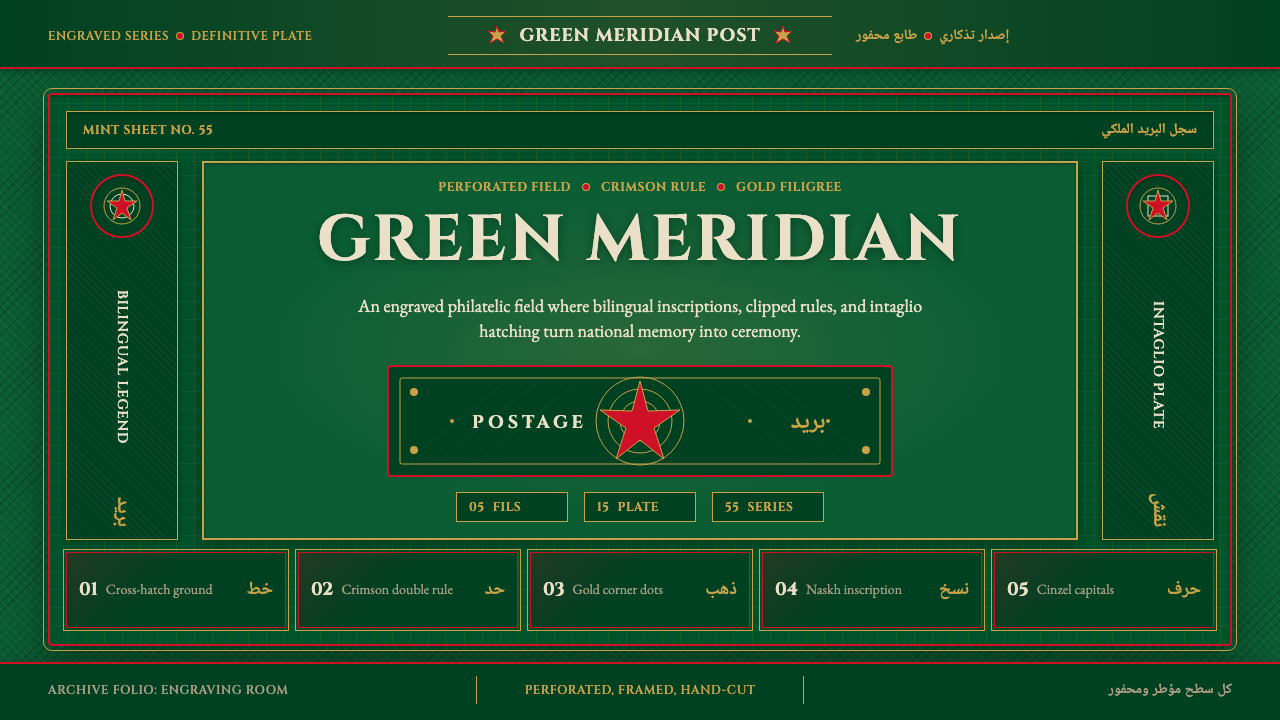
Deep Hashemite green intaglio, crimson borders, and gold filigree corners — a state postal ceremony where Petra and the Dome of the Rock become engraved bilingual vignettes.深沉的哈希姆绿凹版底纹、绯红边线与金色花丝转角——一场国家邮政的庄重仪式,佩特拉与圆顶清真寺化为双语雕版小景。
Hashemite Jordan Postage in briefHashemite Jordan Postage 速览
Hashemite Jordan Postage is a design system distilled from the definitive postage stamp series issued by the Kingdom of Jordan in 1954–55, an era when postage stamps functioned as miniature acts of state — official, ceremonial objects that carried a young kingdom's national imagery and heraldic identity into every hand that touched a letter. The style's foundation is a deep Hashemite green, a color closely associated with the ruling dynasty, rendered in fine intaglio engraving and ruled with crimson borders.哈希姆约旦邮票是一套设计系统,提炼自约旦王国于1954至55年间发行的通用邮票系列——那个年代,邮票承担着国家微缩仪式的功能:一种官方的、庄重的物件,把一个年轻王国的国家意象与纹章身份,传递到每一双触碰信件的手中。这套风格的根基是一种与统治王朝密切关联的深沉哈希姆绿,以精细凹版雕刻呈现,并以绯红边线勾勒。
Every surface in this system behaves as if it has been engraved, perforated, and hand-cut rather than printed flat. Fine cross-hatched line work fills backgrounds and figure shading, gold filigree ornaments the corners in dense, symmetrical patterns, and national landmarks — Petra's Al-Khazneh treasury facade and the Dome of the Rock — appear as small engraved vignettes framed within ornate arabesque borders, exactly as they would on an actual definitive stamp.这套体系中的每一处表面,都表现得像是被雕刻、打孔、手工镂刻而成,而非平面印刷。细密的交叉排线填满背景与人物阴影,金色花丝以致密、对称的图案装饰四角,国家地标——佩特拉的卡兹尼神殿立面与圆顶清真寺——以雕版小景的形式出现,嵌于繁复的阿拉伯式蔓草边框之中,与真实通用邮票上的呈现方式一模一样。
The system is deliberately bilingual, with Naskh-style Arabic script and inscriptional Latin capital letters set side by side within the same ornate frame, reflecting the dual-language convention of official state documents and postage of the era. Every element — border, vignette, filigree, perforation — is oriented toward ceremony and state authority rather than casual decoration.这套体系刻意采用双语呈现,纳斯赫体阿拉伯文与碑铭式拉丁大写字母并列于同一繁复画框之内,反映了那个年代官方国家文件与邮票的双语惯例。每一个元素——边框、小景、花丝、齿孔——都指向庄重的国家权威,而非随意的装饰。
See the Hashemite Jordan Postage design system查看 Hashemite Jordan Postage 完整设计系统
Where does Hashemite Jordan Postage come from?Hashemite Jordan Postage 从何而来?
The Hashemite Kingdom of Jordan, established as an independent state in 1946, issued a series of definitive postage stamps between 1954 and 1955 that became a defining artifact of the young nation's early visual identity. Definitive stamps — the ordinary, everyday denominations used for standard mail, as opposed to limited commemorative issues — were designed to be seen and handled by essentially the entire population over an extended period, making their visual language a kind of unofficial national aesthetic broadcast through daily correspondence.哈希姆约旦王国于1946年成立为独立国家,在1954至1955年间发行了一系列通用邮票,成为这个年轻国家早期视觉身份的代表性产物。通用邮票——用于日常普通邮件的常规面值,区别于限量发行的纪念邮票——被设计为要在相当长的一段时间内,被几乎全体国民所见、所触碰,这使得其视觉语言成为一种通过日常通信广播出去的非正式国家美学。
The 1954–55 series drew its imagery directly from the kingdom's most significant cultural and religious landmarks: the ancient Nabataean city of Petra, with its iconic rock-cut facade known as Al-Khazneh (the Treasury), and the Dome of the Rock in Jerusalem, then under Jordanian administration and one of the most significant sites in Islamic architecture. These images were rendered as small engraved vignettes — a printing tradition, common to state postal engraving worldwide, that used fine intaglio line work to create tonal depth and detail at a very small scale, since stamps had to convey rich imagery within an area barely larger than a postage-stamp-sized rectangle.1954至55年系列直接取材于王国最重要的文化与宗教地标:古老的纳巴泰城市佩特拉,及其标志性的岩凿立面卡兹尼神殿(意为"宝库"),以及耶路撒冷的圆顶清真寺——当时处于约旦管辖之下,是伊斯兰建筑中最重要的场所之一。这些图像以雕版小景的形式呈现——这是一种在全球国家邮政雕刻中普遍存在的印刷传统,利用精细的凹版线条在极小尺度上营造层次深度与细节,因为邮票必须在仅比邮票本身大小略大的矩形区域内,传达丰富的图像信息。
The stamps' engravers worked within a heraldic tradition tracing back to the Great Arab Revolt of 1916–1918, the uprising against Ottoman rule led in part by the Hashemite family, from whom Jordan's monarchy descends. This heraldic lineage supplied the deep green associated with the dynasty, along with a visual seriousness and ceremonial bearing appropriate to a newly sovereign state asserting its identity on the world stage through the most quotidian of objects — a stamp affixed to an ordinary letter.邮票的雕刻师们,工作于一种可追溯至1916至1918年阿拉伯大起义的纹章传统之中——那场起义反抗奥斯曼统治,部分由哈希姆家族领导,约旦王室正是源自这一家族。这份纹章血统提供了与王朝相关联的深沉绿色,以及一种适合一个新近获得主权的国家,通过最日常的物件——贴在一封普通信件上的邮票——在世界舞台上确立自身身份的视觉庄重感与仪式感。
Bilingual text — Arabic in the traditional Naskh calligraphic style paired with inscriptional Latin capitals — reflected both the kingdom's Arabic linguistic identity and the practical necessity of international postal legibility, since stamps needed to be recognizable and processable by postal systems worldwide. This combination of state heraldry, fine intaglio engraving, and bilingual legend established a visual template that this design system now revives as a distinct aesthetic vocabulary, evoking the particular gravity and craftsmanship of mid-twentieth-century state philately.双语文字——传统纳斯赫体书法风格的阿拉伯文,与碑铭式拉丁大写字母并列——既反映了王国的阿拉伯语言身份,也反映了国际邮政可识别性的实际需要,因为邮票需要能被全球邮政系统识别与处理。这种国家纹章、精细凹版雕刻与双语铭记的结合,确立了一套视觉范式,如今这套设计系统将其复兴为一种独树一帜的美学词汇,唤起二十世纪中叶国家集邮特有的庄重感与工艺水准。
What defines the Hashemite Jordan Postage look?Hashemite Jordan Postage 的视觉特征是什么?
Color色彩
The palette is anchored by deep Hashemite green as the dominant field color, ruled and bordered with crimson red, and accented with gold for filigree ornament. These three colors — green, crimson, gold — should appear in disciplined, heraldic proportion rather than an even three-way split.色板以深沉的哈希姆绿作为主导场域色彩,以绯红勾边框线,以金色点缀花丝装饰。这三种颜色——绿、绯红、金——应以有纪律的、纹章式的比例出现,而非平均三分。
Intaglio Engraving Texture凹版雕刻质感
Fine cross-hatched line work should fill backgrounds and shading throughout, simulating the tonal depth achieved by engraved printing plates. This texture is not decorative flourish but the core structural technique that gives the style its sense of hand-cut craftsmanship.细密的交叉排线应贯穿填满背景与阴影,模拟雕版印刷所达到的层次深度。这种质感不是装饰性的花饰,而是赋予这种风格手工雕镂工艺感的核心结构技法。
Typography字体排印
Text is bilingual, pairing traditional Naskh-style Arabic calligraphy with inscriptional Latin capital letters, set within the same ornate frame. Both scripts should carry equal ceremonial weight, neither treated as primary and the other as translation afterthought.文字是双语的,将传统纳斯赫体阿拉伯书法与碑铭式拉丁大写字母并置于同一繁复画框之内。两种文字应承载同等的仪式分量,不应把其中一种当作主体、另一种当作事后翻译。
Engraved Vignette雕版小景
Central imagery should be rendered as a small, framed engraved scene — a landmark or figure isolated within a defined border — rather than a full-bleed photograph or illustration. This vignette treatment is central to the philatelic register the style evokes.中央图像应呈现为一个小型、有框的雕版场景——一处地标或人物被孤立在一个明确的边框之内——而非通栏出血的照片或插图。这种小景处理,是这种风格所唤起的集邮调性的核心所在。
Gold Filigree Corners金色花丝转角
Dense, symmetrical ornamental patterns in gold occupy the corners of the composition, framing the central vignette without overwhelming it. This ornament should feel hand-cut and precise, echoing the fine engraving tradition rather than a broad decorative flourish.致密、对称的金色装饰纹样占据构图的四角,框住中央小景而不压过它。这种装饰应感觉是手工雕镂、精确的,呼应精细雕刻传统,而非泛泛的装饰花饰。
Perforated Edge Logic齿孔边缘逻辑
Where edges appear, they can reference the perforated border of an actual stamp — a visual cue that signals the object is meant to be handled, torn, and affixed rather than viewed as a static poster or plate.若出现边缘处理,可以指涉真实邮票的打孔边线——这是一种视觉提示,传达这件物品是要被拿在手中、撕下并粘贴的,而非作为静态海报或图版来观看。
State Ceremony Bearing国家仪式气度
Every compositional decision should carry a formal, ceremonial weight appropriate to an official state artifact — no casual asymmetry, no playful proportion. The overall bearing is one of a young sovereign nation asserting dignity through its most quotidian object.每一个构图决策都应带有一种适合官方国家产物的正式、仪式性分量——没有随意的非对称,没有俏皮的比例。整体气度是一个年轻主权国家,通过其最日常的物件来主张尊严。
See the Hashemite Jordan Postage design system查看 Hashemite Jordan Postage 完整设计系统
Who shaped Hashemite Jordan Postage?谁塑造了 Hashemite Jordan Postage?
The anonymous engravers who cut the intaglio plates for Jordan's 1954–55 definitive stamp series, translating national landmarks like Petra and the Dome of the Rock into fine cross-hatched vignettes within ornate bilingual frames.为约旦1954至55年通用邮票系列雕刻凹版的匿名雕刻师,他们将佩特拉与圆顶清真寺等国家地标,转译为繁复双语画框内的精细交叉排线小景。
The heraldic visual lineage tracing back to the 1916–1918 uprising against Ottoman rule, led in part by the Hashemite family, which supplied the deep green and ceremonial bearing that this stamp series — and the broader design system it inspired — draws upon.可追溯至1916至1918年反抗奥斯曼统治起义的纹章视觉血统,起义部分由哈希姆家族领导,为这套邮票系列——以及它所启发的更广泛设计系统——提供了深沉的绿色与仪式性气度。
Engravers working within the visual conventions of the Hashemite royal court, whose combination of state heraldry, fine intaglio technique, and bilingual legend established the ceremonial template this design system revives.在哈希姆王室视觉惯例中工作的雕刻师,他们将国家纹章、精细凹版技法与双语铭记相结合,确立了这套设计系统所复兴的仪式性范式。
How do you use Hashemite Jordan Postage today?今天怎么用 Hashemite Jordan Postage?
Applying this style well starts with committing to the small-vignette logic at its core — a single framed image or figure, rendered in fine engraved line work, rather than a full-bleed photograph or flat illustration.要用好这种风格,首先要坚持其核心的小景逻辑——单一的、被框住的图像或人物,以精细的雕版线条呈现,而非通栏出血的照片或扁平插图。
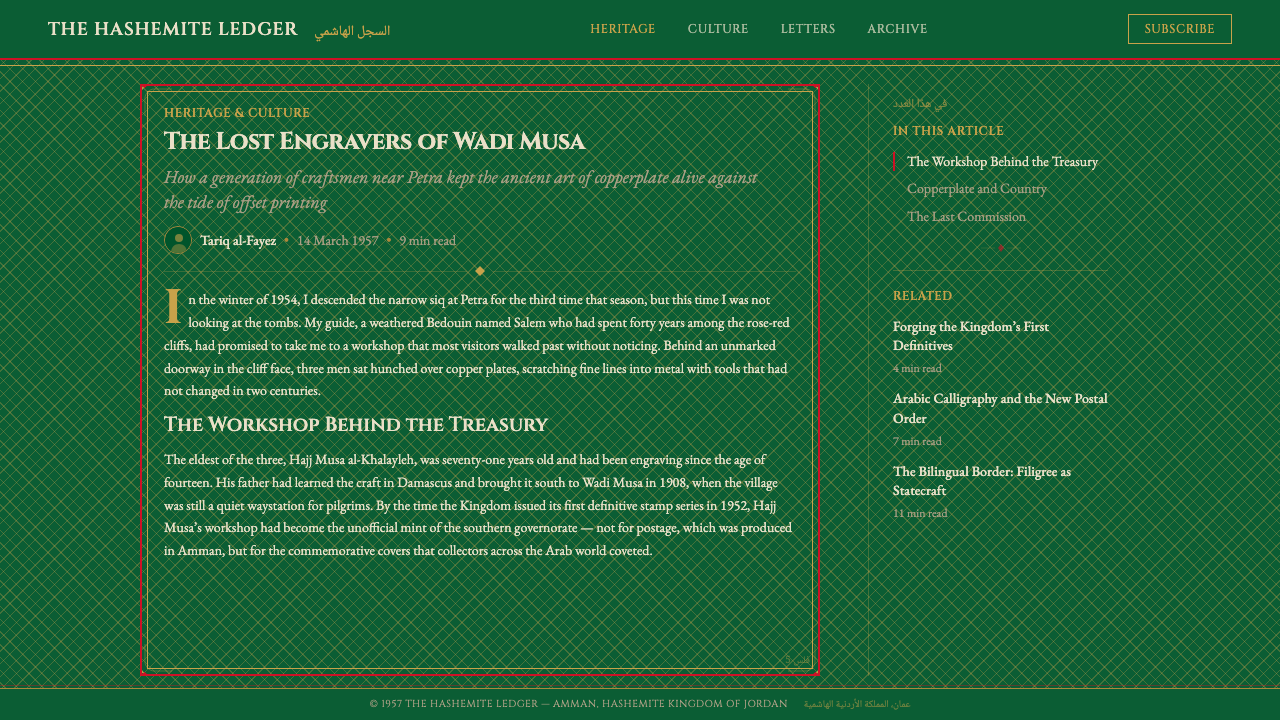
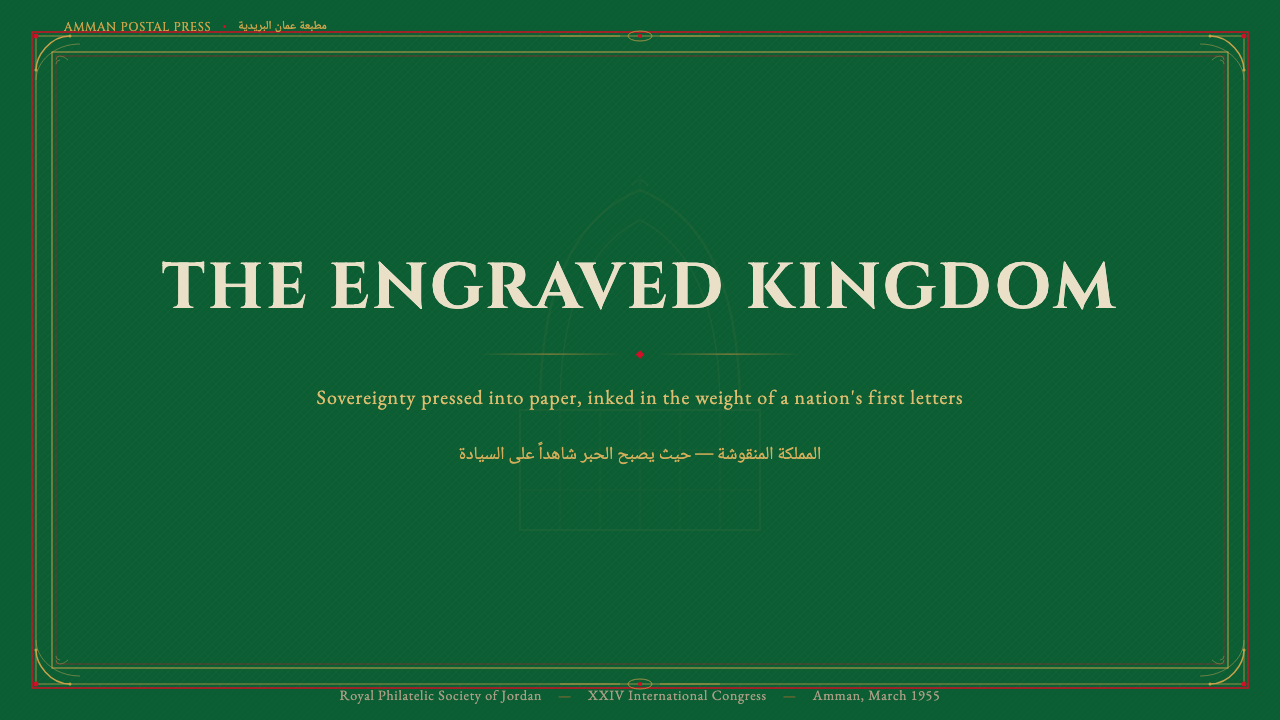
For presentation slides, the style makes a formal, ceremonial cover treatment: a small engraved vignette of an icon or figure centered within a bilingual, filigree-cornered frame against a deep Hashemite-green field, bordered in crimson. Content slides should organize information within similarly framed panels rather than open, borderless layouts, reflecting the stamp's own compact, contained composition.在演示文稿中,这种风格适合做出正式、仪式感的封面处理:一个图标或人物的雕版小景,居中置于一个双语的、花丝转角的画框之内,衬托深沉的哈希姆绿场域,以绯红勾边。内容页应将信息组织在类似的有框面板之内,而非开放、无边框的版面,呼应邮票本身紧凑、有约束的构图。
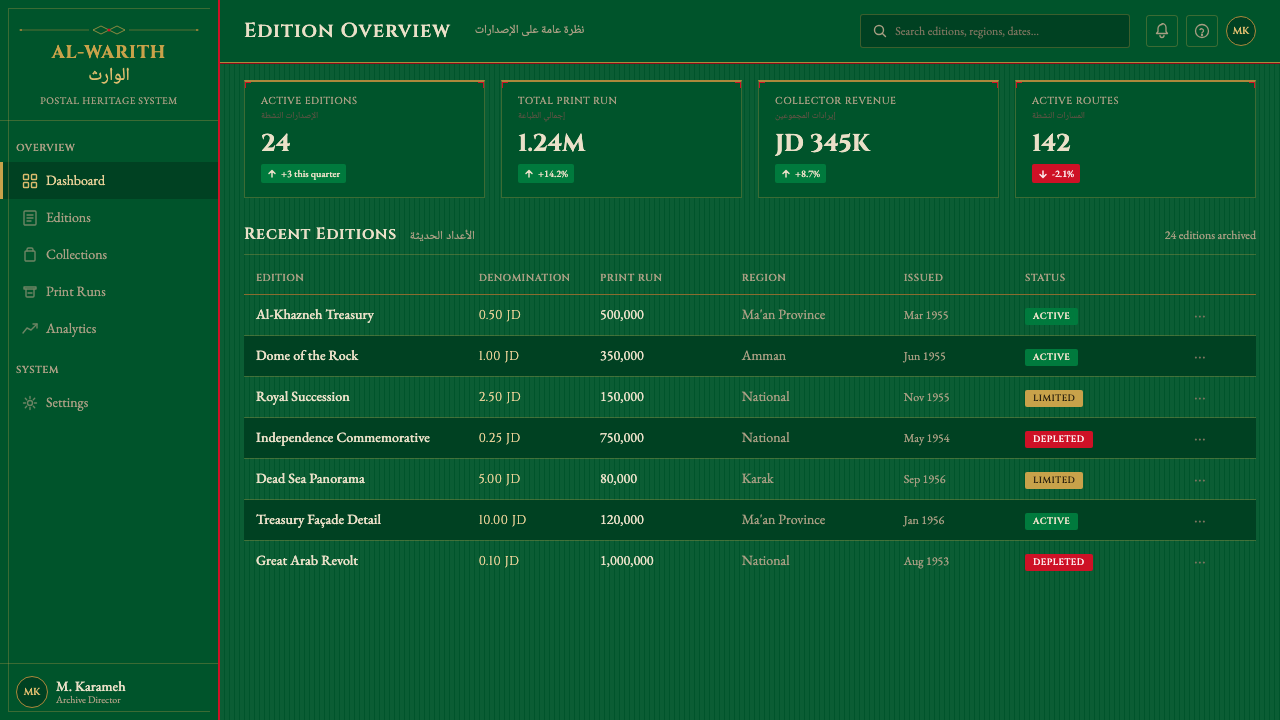
For web interfaces, the style suits institutional, archival, or heritage-focused products — museum digital experiences, state or civic branding, cultural documentation platforms — where deep green fields, crimson-ruled borders, and gold filigree corner ornaments can frame key content sections or hero imagery. Bilingual text treatment, giving equal visual weight to both scripts, reinforces the ceremonial, official register.对于网页界面,这种风格适合机构性、档案性或注重传承的产品——博物馆数字体验、国家或市政品牌、文化记录平台——深沉绿色场域、绯红勾边与金色花丝转角装饰可以框住关键内容区块或主视觉图像。给予两种文字同等视觉分量的双语文字处理,能强化这种仪式性、官方性的调性。
For editorial and marketing contexts, the style rewards restraint and formality — a single engraved vignette per section, framed and bordered, rather than a dense collage of imagery. Pull quotes or captions can be rendered in inscriptional capital letters to echo the stamp's own typographic gravity.对于编辑与营销场景,这种风格奖励克制与正式感——每个区块一处雕版小景,加框加边,而非密集的图像拼贴。引言或图说可以用碑铭式大写字母排版,呼应邮票本身的字体庄重感。
A common mistake is applying the ornate filigree pattern too broadly, covering large areas rather than confining it to corner accents around a central vignette, which dilutes its ceremonial precision. Another mistake is using only one language rather than the bilingual pairing that is central to the style's historical and cultural accuracy.一个常见的错误,是把繁复的花丝纹样应用得过于宽泛,覆盖大面积区域,而非将其限定为围绕中央小景的转角点缀,这会稀释其仪式性的精确感。另一个错误,是只使用一种语言,而非这种风格历史与文化准确性所核心依赖的双语并置。
See the Hashemite Jordan Postage design system查看 Hashemite Jordan Postage 完整设计系统
Hashemite Jordan Postage — FAQHashemite Jordan Postage · 常见问题
Why is the bilingual text treatment so central to this style?为什么双语文字处理对这种风格如此核心?
Because it directly reflects historical fact: Jordan's 1954–55 definitive stamps carried both Arabic and Latin script side by side, reflecting both the kingdom's linguistic identity and the practical need for international postal legibility. Reducing the style to a single language strips out this dual-audience, dual-heritage quality that gives the style its specific historical grounding.因为它直接反映了历史事实:约旦1954至55年的通用邮票,将阿拉伯文与拉丁文并列呈现,既反映了王国的语言身份,也反映了国际邮政可识别性的实际需要。将这种风格简化为单一语言,会剥离掉赋予其特定历史根基的这种双重受众、双重传承的品质。
Is this the same as generic vintage or antique design aesthetics?这和泛泛的复古或古董设计美学是一回事吗?
Related but more specific. Generic vintage aesthetics often borrow loosely from many eras and traditions without a clear anchor. This style is anchored precisely in one artifact type — mid-twentieth-century state definitive postage stamps — and one specific national heraldic tradition, giving it a more disciplined, ceremonial character than a broad 'antique' mood board would produce.相关但更为特指。泛泛的复古美学常常松散地从多个时代与传统中借鉴,缺乏明确的锚点。这种风格精确地锚定于一种特定的产物类型——二十世纪中叶国家通用邮票——以及一种特定的国家纹章传统,这使它比一块宽泛的"古董"情绪板具有更有纪律、更具仪式感的性格。
Can the color palette be adapted to a different national color scheme?色板能改编为不同的国家配色方案吗?
The structural logic — a dominant heraldic field color, crimson-ruled borders, gold filigree, engraved vignette — can transfer to other national color schemes, but the deep Hashemite green specifically ties this variant to Jordan's dynastic heraldry. Changing the base color would produce a related but distinct national-philatelic style rather than this specific one.结构逻辑——主导性的纹章场域色彩、绯红勾边框线、金色花丝、雕版小景——可以移植到其他国家配色方案,但深沉的哈希姆绿特指将这一变体与约旦王朝纹章绑定。改变基础色彩会产生一种相关但不同的国家集邮风格,而非这一特定风格本身。
What kind of imagery works best as the central engraved vignette?什么样的图像最适合作为中央雕版小景?
Architectural landmarks, historical figures, or emblematic national symbols work best, rendered with fine cross-hatched line work rather than photographic realism. The imagery should feel monumental and representative — a single, dignified subject worthy of ceremonial framing — rather than a casual or everyday scene.建筑地标、历史人物或象征性的国家符号最为适合,以精细的交叉排线呈现,而非照片式的写实。图像应感觉是纪念碑式、有代表性的——一个值得仪式性画框的、庄重的单一主体——而非随意或日常的场景。
Does this style suit modern digital products, or is it limited to print-adjacent contexts?这种风格适合现代数字产品吗,还是仅限于印刷相关场景?
It can work well in digital contexts wanting to evoke institutional gravity, heritage, or ceremonial formality — museum platforms, cultural archives, state or civic digital services. It struggles in contexts calling for casual friendliness or rapid, lightweight interaction, since its entire visual logic is built around formal, considered ceremony rather than everyday ease.它在想要唤起机构庄重感、传承感或仪式性正式感的数字场景中能表现良好——博物馆平台、文化档案、国家或市政数字服务。它在需要随意亲和感或快速、轻量交互的场景中会显得力不从心,因为它的整套视觉逻辑都建立在正式、深思的仪式之上,而非日常的便捷。
Related design styles相关设计风格
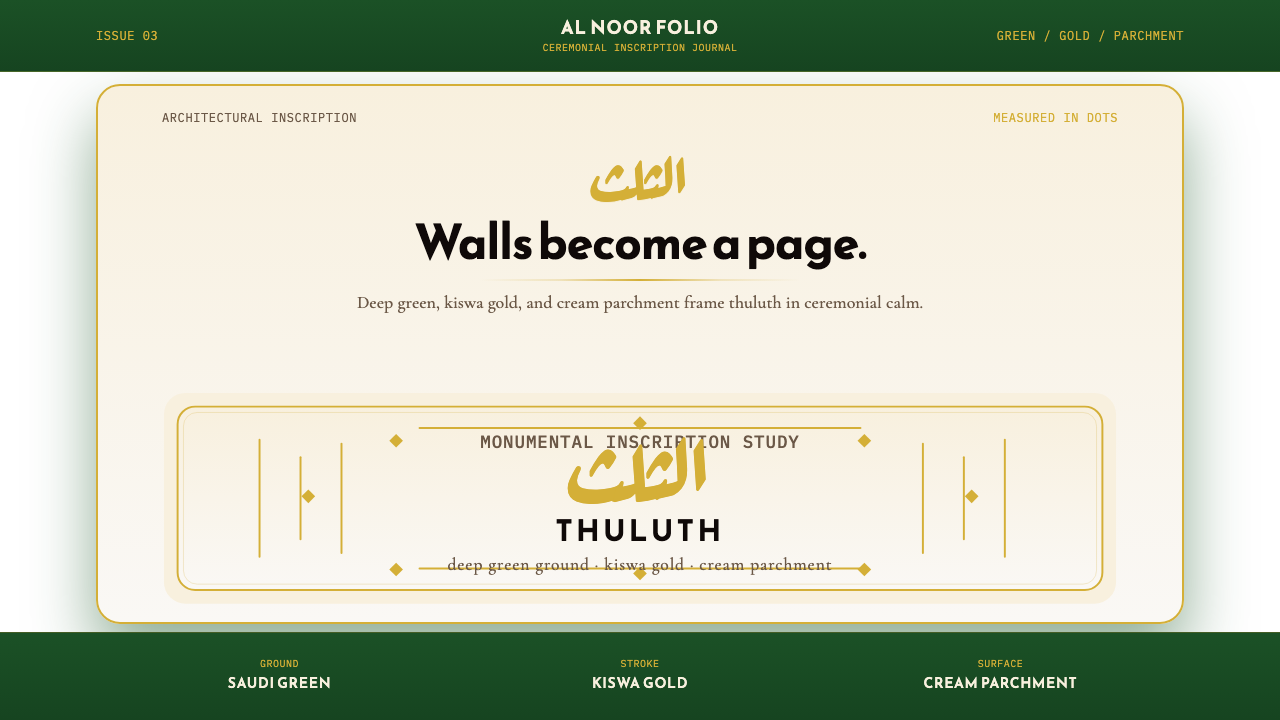 Saudi Thuluth CalligraphyMonumental calm in gold. Deep green, thuluth type, and cream parchment symmet…金色庄严。深绿底、苏鲁斯体与奶油纸面形成对称构图。
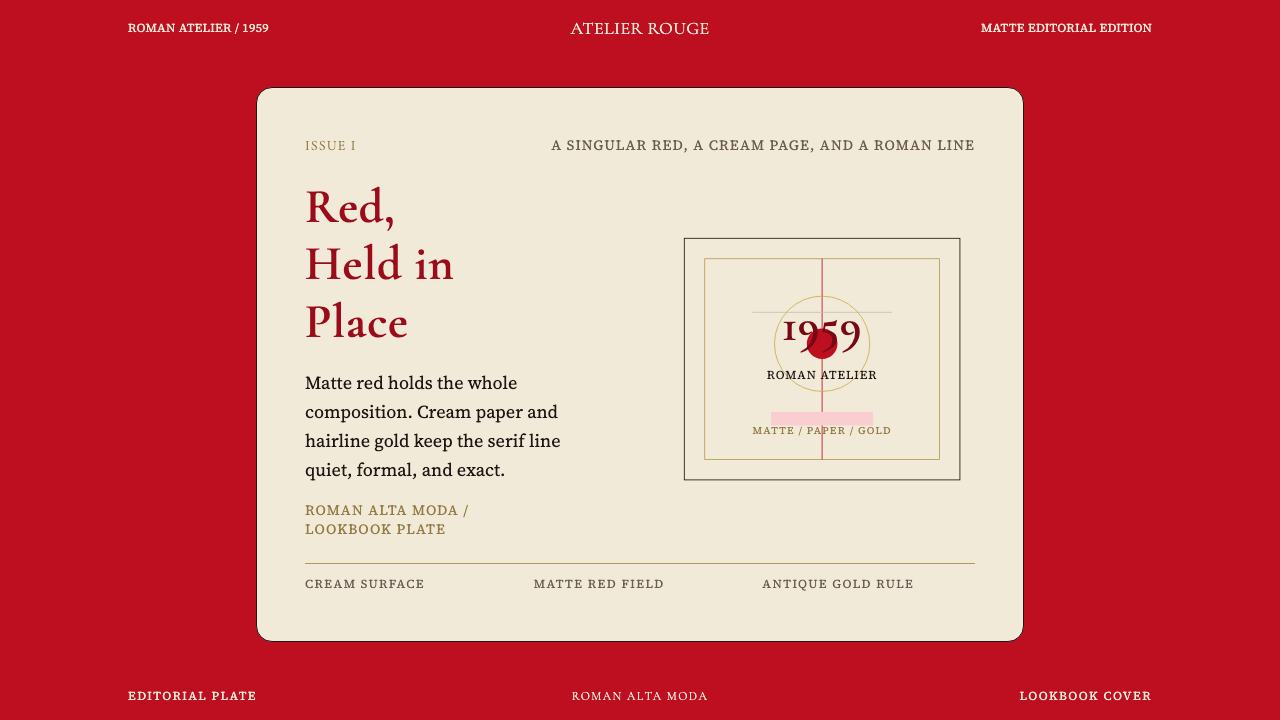 Valentino Rouge Couture (1959)Matte couture red holds the page. Cream paper and hairline gold keep it cerem…哑光高定红统领全页,奶油纸面与细金线让它更庄严。
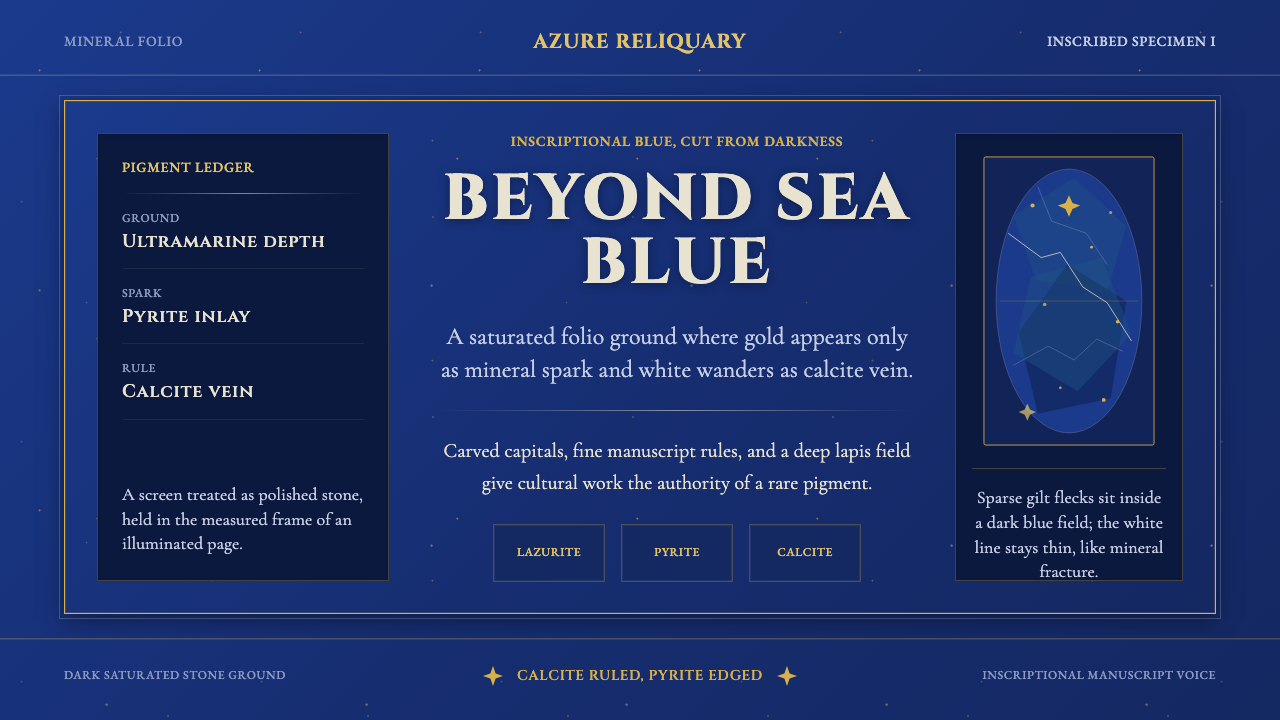 Badakhshan Lapis LazuliStone as manuscript. Ultramarine field, pyrite flecks, calcite veins, carved…以石为页:群青底、黄铁矿金点、方解石纹、铭文大写。
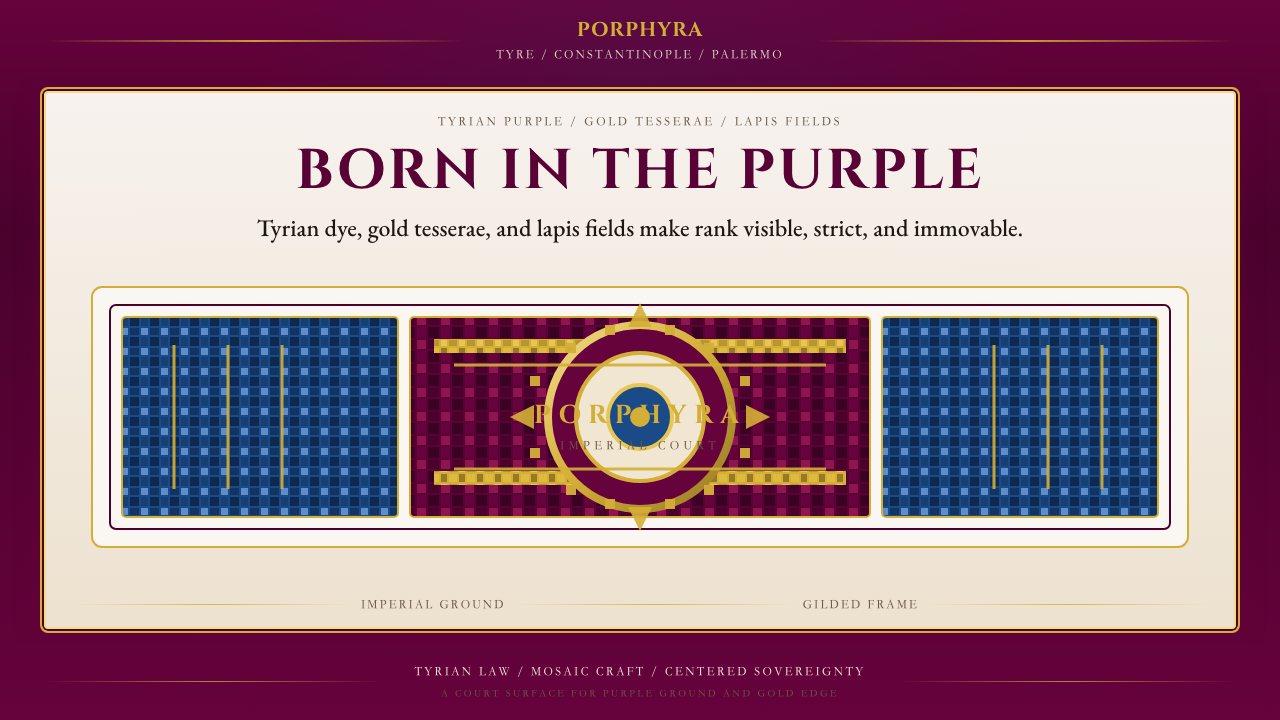 Byzantine Tyrian Purple (Imperial Court)Imperial rank made visible. Tyrian purple, gold tesserae, and centered symmet…帝国权威可见化:泰尔紫、金镶嵌与居中对称。
 Cambodian Angkor Bas-ReliefStone speaks in shadow. Olive registers and antique gold carve a torchlit arc…石在暗影中叙事:苔绿横栏与古金刻出火光档案。
 Naskh Quranic (1500)Reverence in every stroke. Ivory parchment, gold rosettes, and lapis framing.每一笔都庄重。象牙纸、金箔花饰与青金石边框。